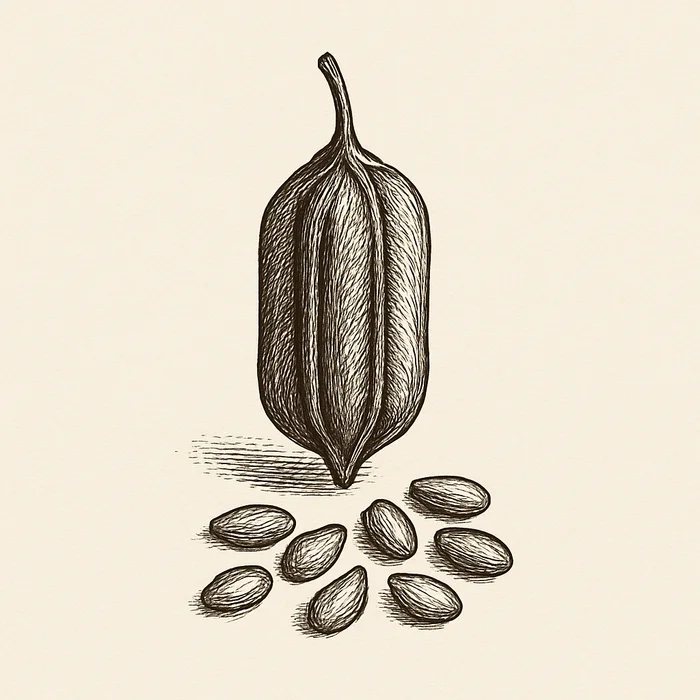
Sesame Seeds
The oldest known oilseed crop — unhulled sesame contains more calcium per gram than milk, and its unique lignan sesamin lowers LDL cholesterol and systolic blood pressure through mechanisms distinct from statins.
Why It Matters for Longevity
Sesame seeds deliver sesamin and sesamolin, lignans found in no other common food at meaningful concentrations. Their cardiovascular effects operate through at least two independent pathways: activation of peroxisome proliferator-activated receptor alpha (PPARα), which upregulates hepatic fatty acid oxidation and suppresses lipogenic enzyme activity; and enhancement of endothelial nitric oxide synthase (eNOS), which improves vascular tone by increasing nitric oxide bioavailability. Both pathways are mechanistically distinct from HMG-CoA reductase inhibition (the statin mechanism), making sesamin a complementary rather than redundant cholesterol intervention.
A meta-analysis of 7 RCTs (212 participants, intervention periods 28–60 days) found that sesamin supplementation reduced LDL-cholesterol by approximately 8.4 mg/dL and total cholesterol by 10.9 mg/dL, and decreased systolic blood pressure by 3.7 mmHg, with no significant effect on HDL, triglycerides, or body weight (Sun et al., 2022, Front Endocrinol). The LDL reduction mechanism involves both PPARα-driven reduction of hepatic cholesterol synthesis and sesamin's inhibition of Δ5 and Δ6 desaturases, shifting arachidonic acid toward less pro-inflammatory metabolites.
A randomized crossover trial in 26 postmenopausal women (50 g sesame powder daily for 5 weeks) found that sesame ingestion reduced LDL-cholesterol by 10%, improved the LDL/HDL ratio by 6%, and cut oxidized LDL as measured by thiobarbituric acid reactive substances (TBARS) by 23%. Gamma-tocopherol — the vitamin E form predominant in sesame — rose 73% and alpha-tocopherol by 18%, consistent with sesamin's known ability to spare vitamin E from oxidative degradation (Wu et al., 2006, J Nutr).
A 2-month RCT in 50 patients with knee osteoarthritis (40 g sesame seed daily) found significant reductions in serum malondialdehyde (MDA), total cholesterol, and LDL-cholesterol compared to controls, with no changes in the control group, demonstrating that sesame's antioxidant effects extend to systemic oxidative stress markers, not just lipid panels (Haghighian et al., 2014, Health Promot Perspect).
The Calcium Story
The calcium story depends entirely on the hull. Unhulled sesame seeds provide 975 mg calcium per 100 g — nearly 3× the calcium in milk. Hulled sesame seeds contain only 60 mg — a 16-fold reduction. Most commercial tahini uses hulled seeds. For bone health, seek out unhulled (whole) sesame or unhulled tahini specifically labeled as such. Black sesame seeds, popular in East Asian cuisine, are always unhulled and reliably high in calcium.
Copper and manganese — both cofactors for superoxide dismutase (SOD), the body's primary intracellular antioxidant enzyme — are among the highest of any food in sesame seeds: approximately 4.1 mg copper and 2.5 mg manganese per 100 g. These concentrations make sesame one of the most efficient dietary sources of SOD cofactors, supporting antioxidant defense independently of the lignan mechanisms.
Inflammation and Preclinical Evidence
Sesame lignans show anti-inflammatory activity in cell and animal models through suppression of NF-κB signaling, reductions in prostaglandin E2, and inhibition of 5-lipoxygenase. A 2023 review of sesamin and sesamolin across 13 human intervention studies found consistent reductions in TNF-α, hs-CRP, and MDA in populations including type 2 diabetics, rheumatoid arthritis patients, and knee osteoarthritis patients (Hadipour et al., 2023, Food Sci Nutr). Human intervention data for anti-inflammatory effects is more limited and newer than for flaxseed lignans, but the direction is consistent across studies.
How to Use It
Whole seeds in salads, on bread (simit), or as garnish. Ground as tahini for hummus and dips. Unhulled seeds for maximum calcium. Black sesame for toasty, smoky flavor. Lightly toast white sesame seeds to enhance nuttiness. Store in a cool, dark place; the lignan content is stable at room temperature but the polyunsaturated fat can turn rancid in heat.
What to Pair It With
| Ingredient | Why | Tradition |
|---|---|---|
| Chickpeas | Hummus: complete protein + complementary minerals | Middle Eastern |
| Dark leafy greens | Dual calcium sources (goma-ae: sesame + spinach) | East Asian |
| Ginger | Classic sesame-ginger aromatic combination | East Asian |
| Honey | Halvah: traditional sesame-honey confection | Middle Eastern |
| Whole grains | Sesame on bread, rice, or noodles; mineral complement | Global |
Flavor Profile
Nutty and sweet with warm, toasty notes that intensify with roasting. Black sesame seeds have a deeper, smokier character. Ground into tahini, the texture becomes rich and creamy with a slightly bitter finish. Whole seeds provide a satisfying tiny crunch. The aroma when toasting is warm and distinctive.
The Science
- Sun et al., 2022, Front Endocrinol: Meta-analysis of 7 RCTs (212 participants) — sesamin supplementation reduced LDL-c by 8.4 mg/dL, total cholesterol by 10.9 mg/dL, and systolic BP by 3.7 mmHg via PPARα activation and eNOS upregulation.
- Wu et al., 2006, J Nutr: Crossover RCT (26 postmenopausal women, 5 weeks, 50 g/day) — sesame reduced LDL-C 10%, improved LDL/HDL ratio 6%, cut oxidized LDL (TBARS) 23%, raised gamma-tocopherol 73%.
- Haghighian et al., 2014, Health Promot Perspect: RCT (50 OA patients, 2 months, 40 g/day) — sesame significantly reduced MDA, total cholesterol, and LDL-C versus controls.
- Hadipour et al., 2023, Food Sci Nutr: Review of 13 human intervention studies — sesamin/sesamolin consistently reduced TNF-α, hs-CRP, and MDA across multiple inflammatory disease populations.
- Sesamin modulates hepatic cholesterol metabolism via PPARα and eNOS pathways, independently of the statin (HMG-CoA reductase) mechanism.
- Unhulled sesame: 975 mg calcium/100 g (nearly 3× milk); hulled: only 60 mg.
References
- Sun Y, Ren J, Zhu S, et al. The Effects of Sesamin Supplementation on Obesity, Blood Pressure, and Lipid Profile: A Systematic Review and Meta-Analysis of Randomized Controlled Trials. Front Endocrinol (Lausanne). 2022;13:842152. PMID: 35311241. doi:10.3389/fendo.2022.842152
- Wu WH, Kang YP, Wang NH, Jou HJ, Wang TA. Sesame ingestion affects sex hormones, antioxidant status, and blood lipids in postmenopausal women. J Nutr. 2006;136(5):1270-1275. PMID: 16614415. doi:10.1093/jn/136.5.1270
- Haghighian MK, Alipoor B, Eftekhar Sadat B, et al. Effects of Sesame Seed Supplementation on Lipid Profile and Oxidative Stress Biomarkers in Patients with Knee Osteoarthritis. Health Promot Perspect. 2014;4(1):90-97. PMID: 25097842. doi:10.5681/hpp.2014.012
- Hadipour E, Emami SA, Tayarani-Najaran N, Tayarani-Najaran Z. Effects of sesame (Sesamum indicum L.) and bioactive compounds (sesamin and sesamolin) on inflammation and atherosclerosis: A review. Food Sci Nutr. 2023;11(8):4095-4116. PMID: 37457142.
Key Nutrients
| Nutrient | Per 100g | Notes |
|---|---|---|
| Sesamin + sesamolin | 300–600 mg | Unique lignans; metabolized to bioactive catechol forms in liver; activate PPARα and eNOS |
| Calcium | 975 mg unhulled; 60 mg hulled | Hull removal reduces calcium 16×; choose unhulled for bone health |
| Copper + manganese | 4.1 mg Cu; 2.5 mg Mn | Cofactors for SOD antioxidant enzyme; among highest of any food |
| Gamma-tocopherol | ~34 mg | Sesamin spares vitamin E from oxidative degradation; gamma form rises 73% with sesame intake |