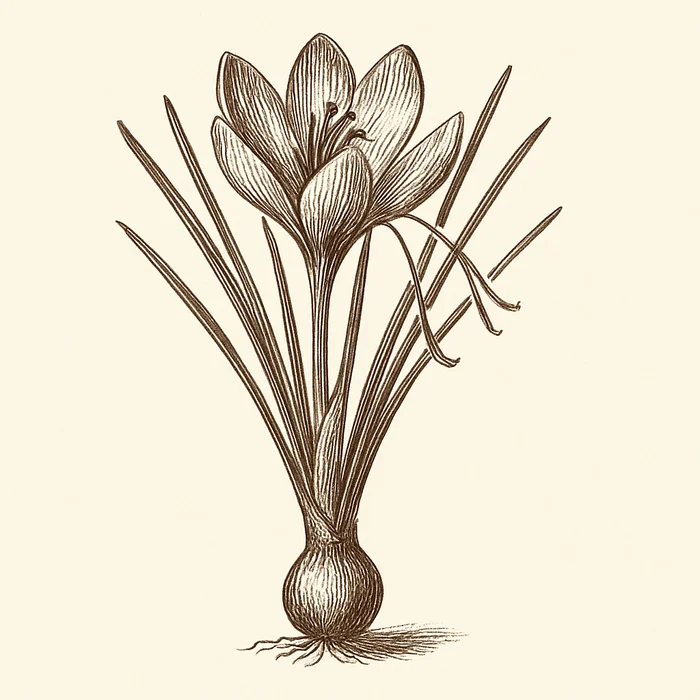
Saffron
Saffron is used in the Longevity Diet's black rice with shrimp dish at approximately 4 g per serving, contributing both flavor and bioactive compounds. At culinary doses, it is one of the few spices with a serious clinical trial record — across depression, cognitive decline, and macular degeneration — that cannot be dismissed as merely in vitro or animal-model evidence.
Why It Matters for Longevity
Crocin, Crocetin, and Safranal: The Bioactive Architecture
Saffron's biological effects trace to three compounds: crocin, a water-soluble carotenoid glycoside responsible for the deep yellow color; crocetin, its aglycone form; and safranal, a volatile monoterpene aldehyde that gives saffron its characteristic aroma and has demonstrated independent neurological activity. Crocin and crocetin are structurally unusual carotenoids — unlike beta-carotene or lycopene, they are highly water-soluble, which affects their distribution in the body and their ability to cross the blood-brain barrier, a property demonstrated in animal pharmacokinetic studies. Their antioxidant mechanism involves direct free radical quenching and inhibition of lipid peroxidation, with ORAC values among the highest measured for plant-derived carotenoids (Rios et al., 1996, Phytother Res).
Cognitive Aging and Alzheimer's Disease
The most clinically significant finding for saffron and longevity concerns its performance against pharmaceutical comparators in Alzheimer's disease. Akhondzadeh et al. ran a 22-week multicenter, randomized, double-blind controlled trial comparing saffron extract at 30 mg/day to donepezil — a standard-of-care acetylcholinesterase inhibitor — in patients with mild-to-moderate Alzheimer's disease. Saffron performed comparably to donepezil on cognitive outcome measures, with fewer gastrointestinal adverse effects (Akhondzadeh et al., 2010, Psychopharmacology). The proposed mechanism involves crocin's neuroprotective activity: inhibition of amyloid beta aggregation, reduction of oxidative stress in hippocampal neurons, and upregulation of BDNF (brain-derived neurotrophic factor) signaling. A 30 mg/day dose of saffron extract corresponds to roughly 7–8 saffron threads per day — below the culinary quantity in a typical saffron rice dish.
Depression and Mood: Meta-Analytic Evidence
Saffron's antidepressant activity has now been evaluated in a meta-analysis of 12 RCTs by Dai, Chen, and Wang (2020), which found that saffron produced better improvement in depressive symptoms than placebo and was as effective as synthetic antidepressants (SSRIs and tricyclics), with no significant difference in adverse event rates between saffron, placebo, or drug comparators (Dai et al., 2020, J Nerv Ment Dis). The mechanism involves at least two pathways: monoamine modulation (safranal and crocin inhibit serotonin reuptake in a mechanism analogous to SSRIs) and NMDA receptor antagonism by crocin, which blocks excitotoxic glutamate signaling. Lopresti and Drummond's earlier systematic review (2014) established these mechanisms and confirmed reproducibility across multiple independent RCTs (Lopresti & Drummond, 2014, Hum Psychopharmacol).
Depression and cognitive decline are both independent risk factors for reduced healthspan and lifespan in large cohort data — not merely quality-of-life concerns. An intervention that reduces depressive symptom burden through a dietary-dose spice represents a meaningful longevity lever, particularly in populations where SSRI tolerance is poor.
Eye Health: Age-Related Macular Degeneration
The most thoroughly replicated effect of saffron supplementation may be its benefit for age-related macular degeneration (AMD). A randomized, double-blind, placebo-controlled crossover trial in 100 patients over 50 with mild/moderate AMD found that 20 mg/day oral saffron for 3 months improved mean best-corrected visual acuity by 0.69 letters versus placebo (p=0.001) and reduced multifocal electroretinogram latency by 0.17 ms (p=0.04) — indicating improved retinal signal transmission, not just subjective vision quality. Among participants already taking AREDS (standard AMD supplements), saffron additionally improved mfERG response density by 2.8% (p=0.038), suggesting additive rather than redundant mechanisms (Broadhead et al., 2019, Graefes Arch Clin Exp Ophthalmol).
An earlier crossover trial (n=25 patients, 20 mg/day for 3 months) using focal electroretinography found that saffron increased fERG amplitude by a mean of 0.25 log µV versus a negligible change of −0.003 log µV under placebo (p<0.01), and reduced fERG thresholds by 0.26 log units — a measurable improvement in photoreceptor sensitivity (Falsini et al., 2010, Invest Ophthalmol Vis Sci). A longitudinal follow-up of 29 patients supplementing for an average of 14 months found that mean visual acuity improved from 0.75 to 0.9 (approximately two Snellen lines) and these gains were sustained throughout the entire follow-up period (Piccardi et al., 2012, Evid Based Complement Alternat Med). The consistency across three independent trials from different centers with objective electrophysiological outcomes is unusual in nutritional ophthalmology. The mechanism involves crocin's antioxidant protection of photoreceptors from light-induced oxidative stress and its anti-apoptotic activity in retinal pigment epithelium cells.
AMD affects approximately 8–10% of people over 65 worldwide and is a leading cause of irreversible vision loss in high-income countries. Any intervention with replicated, objectively measured efficacy at a dose achievable through regular cooking deserves attention as a preventive health strategy.
Antioxidant Mechanism
At the biochemical level, crocin and crocetin are potent free radical scavengers. They quench singlet oxygen, inhibit lipid peroxidation chain reactions at the membrane surface, and chelate metal ions that catalyze Fenton chemistry. These mechanisms operate in parallel with crocin's neuroprotective and retino-protective effects — the same compound doing antioxidant work in multiple tissue compartments simultaneously.
How to Use It
Steep saffron threads in warm liquid (broth or water, 40–60°C) for 10–15 minutes before adding to rice dishes — this releases crocin and maximizes water-soluble bioavailability. Use in black rice, risotto, paella, and bouillabaisse. The culinary dose in a typical saffron rice dish (a large pinch, ~0.1–0.3 g) corresponds to roughly 1–3 mg of crocin, below the 20–30 mg saffron supplement dose used in clinical trials — but regular daily use across weeks contributes cumulative exposure.
What to Pair It With
| Ingredient | Why | Tradition |
|---|---|---|
| black rice | Overlapping antioxidant mechanisms: crocin (carotenoid) + anthocyanins (flavonoid) | The Longevity Diet |
| shrimp | Traditional Mediterranean/Persian pairing in rice and fish dishes | The Longevity Diet |
| arborio rice | Risotto Milanese — classic Northern Italian preparation | General culinary |
| fish broth | Aqueous extraction base releases crocin from threads | General culinary |
| legumes | Saffron-spiced lentil soups in Persian and Moroccan traditions | General culinary |
Synergies
- Black Rice (complement): Saffron's crocin pigments and black rice's anthocyanins create overlapping antioxidant mechanisms (carotenoid + flavonoid pathways), amplifying overall antioxidant capacity in the dish.
- Extra-Virgin Olive Oil (synergy): Fat solubilizes saffron's fat-soluble compounds (safranal) and enhances bioavailability of carotenoids; traditional Mediterranean pairing in rice and fish dishes.
Flavor Profile
Taste: floral, honey-like, subtly bitter, earthy. Aroma: haylike, metallic-floral, complex, warm. Texture: powder when ground, thread-like stigmas. Category: aromatic spice / colorant.
The Science
- Akhondzadeh et al., 2010, Psychopharmacology: 22-week multicenter RCT; saffron 30 mg/day vs. donepezil in mild-to-moderate Alzheimer's disease — comparable cognitive outcomes, fewer gastrointestinal adverse effects with saffron.
- Lopresti & Drummond, 2014, Hum Psychopharmacol: Systematic review confirming antidepressant efficacy across multiple RCTs; mechanisms include monoamine modulation and NMDA receptor antagonism.
- Dai et al., 2020, J Nerv Ment Dis: Meta-analysis of 12 RCTs; saffron superior to placebo and equivalent to synthetic antidepressants; no significant difference in adverse event rates.
- Broadhead et al., 2019, Graefes Arch Clin Exp Ophthalmol: RCT n=100 AMD patients; saffron 20 mg/day improved BCVA by 0.69 letters vs. placebo (p=0.001); reduced mfERG latency by 0.17 ms (p=0.04).
- Falsini et al., 2010, Invest Ophthalmol Vis Sci: RCT n=25 early AMD; saffron 20 mg/day increased fERG amplitude by 0.25 log µV; reduced flicker sensitivity threshold by 0.26 log units (p<0.01 vs. placebo).
- Piccardi et al., 2012, Evid Based Complement Alternat Med: 14-month open-label follow-up (n=29); visual acuity improved from 0.75 to 0.9 (two Snellen lines); improvements sustained throughout.
- Rios et al., 1996, Phytother Res: Crocin and crocetin free radical scavenging activity and lipid peroxidation inhibition across multiple assay systems.
References
- Akhondzadeh S, Sabet MS, Harirchian MH, et al. A 22-week, multicenter, randomized, double-blind controlled trial of Crocus sativus in the treatment of mild-to-moderate Alzheimer's disease. Psychopharmacology (Berl). 2010;207(4):637-43. PMID: 19838862. doi:10.1007/s00213-009-1706-1
- Lopresti AL, Drummond PD. Saffron (Crocus sativus) for depression: a systematic review of clinical studies and examination of underlying antidepressant mechanisms of action. Hum Psychopharmacol. 2014;29(6):517-27. PMID: 25384672. doi:10.1002/hup.2434
- Dai L, Chen L, Wang W. Safety and Efficacy of Saffron (Crocus sativus L.) for Treating Mild to Moderate Depression: A Systematic Review and Meta-analysis. J Nerv Ment Dis. 2020;208(4):269-276. PMID: 32221179. doi:10.1097/NMD.0000000000001118
- Broadhead GK, Grigg JR, McCluskey P, Hong T, Schlub TE, Chang AA. Saffron therapy for the treatment of mild/moderate age-related macular degeneration: a randomised clinical trial. Graefes Arch Clin Exp Ophthalmol. 2019;257(1):31-40. PMID: 30343354. doi:10.1007/s00417-018-4163-x
- Falsini B, Piccardi M, Minnella A, et al. Influence of saffron supplementation on retinal flicker sensitivity in early age-related macular degeneration. Invest Ophthalmol Vis Sci. 2010;51(12):6118-24. PMID: 20688744. doi:10.1167/iovs.09-4995
- Piccardi M, Marangoni D, Minnella AM, et al. A longitudinal follow-up study of saffron supplementation in early age-related macular degeneration: sustained benefits to central retinal function. Evid Based Complement Alternat Med. 2012;2012:429124. PMID: 22852021. doi:10.1155/2012/429124
- Rios JL, Recio MC, Giner RM, Máñez S. An update review of saffron and its active constituents. Phytother Res. 1996;10(3):189-193. PMID: 25829569
Key Nutrients
| Nutrient | Per 100g | Notes |
|---|---|---|
| Crocin | ~6–10 g (as dry stigmas) | Water-soluble carotenoid glycoside; bioavailability enhanced by aqueous extraction (steeping threads in warm liquid); crosses the blood-brain barrier in animal studies. |
| Safranal | ~0.5–1 g | Volatile monoterpene aldehyde responsible for aroma; modulates serotonin reuptake and GABA-A receptors; anxiolytic and antidepressant activity at culinary doses. |
| Riboflavin (B2) | ~0.27 mg | Minor contribution at culinary quantities; riboflavin supports mitochondrial energy metabolism. |