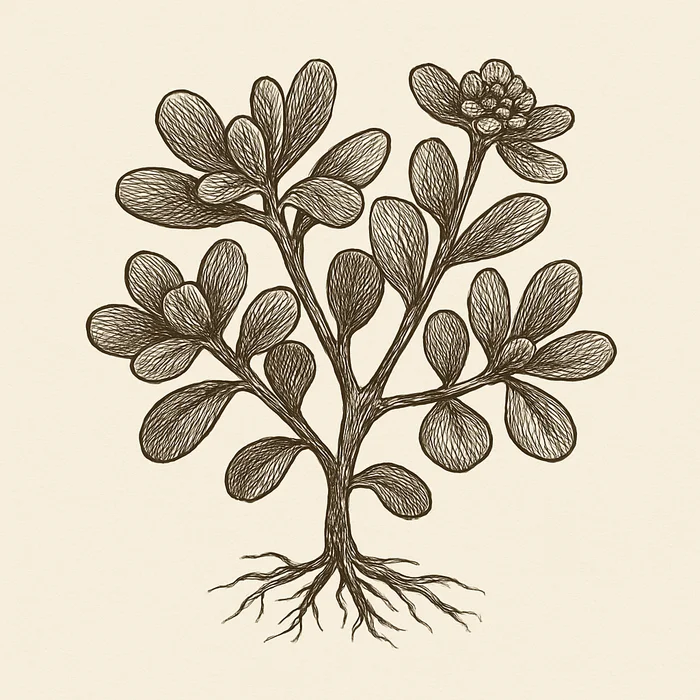
Purslane
A succulent weed growing in sidewalk cracks across the world, purslane is the richest leafy vegetable source of omega-3 fatty acids — and one of the few land plants that contains preformed EPA. Most people walk past it. Mediterranean and Turkish cooks know better.
Why It Matters for Longevity
The Omega-3 Story: More Than a Weed, Less Than a Fish
No green vegetable comes close to purslane for omega-3 content. Purslane provides 300–400 mg of alpha-linolenic acid (ALA) per 100 g of fresh weight — roughly seven times the ALA found in an equivalent amount of spinach (Uddin et al., 2014, ScientificWorldJournal). ALA makes up nearly 50% of its total fatty acid profile, with the omega-6 fraction (linoleic acid) at just 14%, giving purslane one of the most favorable omega-3 to omega-6 ratios of any plant food.
That figure alone would make purslane interesting for plant-based diets, where ALA is the only dietary omega-3 source. But purslane goes a step further. It contains a small but measurable quantity of eicosapentaenoic acid (EPA) at approximately 0.01 mg per gram fresh weight, along with trace docosapentaenoic acid (DPA) and docosahexaenoic acid (DHA). In terrestrial plants, EPA is essentially absent — it is, biochemically speaking, a marine fatty acid. Its presence in purslane was first reported in a 1986 letter to the New England Journal of Medicine by Simopoulos and Salem, who proposed purslane as "a terrestrial source of omega-3 fatty acids" (Simopoulos & Salem, 1986, N Engl J Med).
The mechanism behind purslane's exceptional omega-3 accumulation is now partially understood at the molecular level. Researchers isolated two omega-3 fatty acid desaturase genes from purslane — PoleFAD7 and PoleFAD8 — which encode enzymes that convert linoleic acid (18:2 omega-6) to alpha-linolenic acid (18:3 omega-3). Crucially, these genes are stress-inducible: PoleFAD7 is up-regulated by mechanical wounding, while PoleFAD8 responds to cold temperature, with total ALA content in leaves rising significantly under both conditions (Teixeira et al., 2010, J Agric Food Chem). This explains both why purslane accumulates so much ALA — its desaturase machinery is unusually active — and why wild-harvested or stress-grown purslane tends to be nutritionally denser than greenhouse specimens.
For practical nutrition, the EPA content is too small to substitute for oily fish. What matters more is the ALA. The human conversion rate of ALA to EPA is roughly 5–10%, and to DHA around 0.5–5%, constrained by competition with the omega-6 pathway. For people who eat little or no seafood, maximizing dietary ALA intake is the lever most likely to support circulating EPA. Dietary ALA from plant sources has been independently associated with reduced coronary heart disease risk, with evidence for protective effects operating even after accounting for conversion efficiency — purslane's ALA was specifically highlighted as part of this mechanism (de Lorgeril & Salen, 2004, Nutr Metab Cardiovasc Dis). Purslane's contribution is real, not theoretical; it is the best plant-food vehicle for ALA by weight.
Betalain Pigments: Not Anthocyanins
The reddish-purple stems of purslane are visually similar to red-leafed vegetables, but the pigment doing the coloring is entirely different. Purslane contains betalains — the same nitrogen-containing water-soluble pigments found in beets, cactus pear, and dragon fruit — rather than the anthocyanins that color red cabbage, berries, and red onion. This distinction matters biochemically.
Betalains include two structural classes: betacyanins (red-violet, e.g., betanin in beets) and betaxanthins (yellow-orange, e.g., indicaxanthin). Both are potent free-radical scavengers. Their antioxidant mechanism operates through direct electron donation to reactive oxygen species (ROS) and reactive nitrogen species (RNS), quenching oxidative damage to lipid membranes, proteins, and DNA. A comprehensive review of plant betalains confirmed their radical-scavenging activity across in vitro and in vivo studies, and noted that betalains' unique indole-derived nitrogen-containing structure gives them electron-donor capacity exceeding that of many common polyphenols (Khan, 2016, Compr Rev Food Sci Food Saf).
Beyond ROS scavenging, the anti-inflammatory evidence is mechanistically specific. Purslane's alkaloids inhibit the translocation of NF-κB to the nucleus in endothelial cells — blocking the master transcription factor for inflammatory gene expression. Separate work documented that purslane compounds significantly reduced mRNA expression of cyclooxygenase-2 (COX-2) and inducible nitric oxide synthase (iNOS), and suppressed secretion of pro-inflammatory cytokines TNF-α, IL-6, and IL-1β (Rahimi et al., 2019, J Pharmacopuncture). These are the same targets addressed by NSAIDs and, in higher concentration, by pharmaceutical anti-inflammatories — here approached through food.
These mechanisms translate into measurable clinical outcomes even in severe inflammatory conditions. A parallel double-blind randomized controlled trial in 76 patients with rheumatoid arthritis — a disease driven by systemic NF-κB activation and elevated TNF-α — found that purslane capsule supplementation over 8 weeks significantly reduced visual analogue scale pain scores, swollen joint count, tender joint count, and disease activity (DAS28). Inflammatory markers fell: TNF-α and erythrocyte sedimentation rate (ESR) both decreased in the purslane group relative to placebo. Simultaneously, superoxide dismutase activity and total antioxidant capacity rose, confirming a dual anti-inflammatory and antioxidant action in vivo (Karimi et al., 2024, Phytomedicine). Rheumatoid arthritis is a useful stress test for any putative anti-inflammatory food because the disease is mechanistically well-characterized: an effect in RA strongly suggests the biochemical targets are real.
Betalains are heat-labile and water-soluble, which means cooking in water leaches them out and heat degrades their structure. To preserve them, eat purslane raw or at most lightly dressed. The red stems hold the highest betalain concentration; don't discard them.
Metabolic and Glycemic Evidence
The clinical evidence on purslane and metabolic health is unusually robust for a wild green. A 2019 meta-analysis of six randomized controlled trials (352 participants total) found that purslane supplementation reduced fasting blood glucose by 4.54 mg/dl (95% CI: −7.54 to −1.53) and triglycerides by 19.16 mg/dl (95% CI: −38.17 to −0.15), with effects strongest at doses above 1.5 g/day (Hadi et al., 2019, Phytother Res). A larger and more recent meta-analysis nearly doubled the evidence base: pooling 16 randomized controlled trials with 1,122 participants, Jafari et al. found that purslane consumption significantly reduced fasting blood sugar (p < 0.001) and malondialdehyde — a marker of lipid peroxidation — while significantly increasing total antioxidant capacity (p < 0.001) (Jafari et al., 2023, Food Sci Nutr). HbA1c and HOMA-IR did not reach significance in the pooled analysis, suggesting purslane's glycemic effect is most pronounced at the level of acute glucose rather than chronic insulin resistance.
A double-blind placebo-controlled trial in 63 adults with type 2 diabetes treated for 12 weeks found that purslane extract produced a −7.5 ± 5.0 mmHg reduction in systolic blood pressure versus −0.01 ± 0.3 mmHg in controls (P < 0.0001), and among participants who responded to treatment, HbA1c fell by −0.8% ± 0.4% versus −0.6% ± 0.5% in the placebo group (P = 0.03) (Wainstein et al., 2016, J Med Food). The authors concluded that purslane extract is a safe adjunct in type 2 diabetes management.
A separate triple-blinded randomized trial in obese adolescents found that 500 mg of purslane seed powder twice daily for one month produced statistically significant between-group differences in LDL cholesterol and triglycerides, with good tolerability (Sabzghabaee et al., 2014, Med Arh). A 2022 review synthesizing in vitro, animal, and human data across the full spectrum of metabolic syndrome components — obesity, hypertension, dyslipidemia, and dysglycemia — concluded that purslane's combination of ALA, polyphenols, and alkaloids addresses multiple upstream regulators simultaneously, including oxidative stress, atherogenic index, insulin signaling, and adipogenesis (Ebrahimian et al., 2022, Iran J Basic Med Sci).
The mechanisms converge: ALA modulates eicosanoid balance toward less pro-inflammatory prostanoids; betalains suppress NF-κB and COX-2; polyphenols inhibit α-glucosidase activity, slowing glucose absorption; and the mucilaginous soluble fiber in purslane's leaves acts as a physical barrier to carbohydrate absorption in the gut. Each mechanism is independently documented; in a whole-food context they operate together.
Why a Weed Belongs in the Longevity Diet
Purslane is native to North Africa and Southwest Asia but has spread to every inhabited continent — it thrives in disturbed soil, germinates in heat, and grows faster than most cultivated crops. This cosmopolitan range means it has been part of human diets for millennia wherever farming happens. The Mediterranean tradition of eating it is not incidental to its nutritional profile; it is the reason the profile was noticed.
In Greece, purslane (glystrida) goes raw into horiatiki variations or dressed simply with olive oil and lemon. In Turkey, semizotu appears in meze salads with yogurt or in börek fillings. Across the Levant, purslane is combined with tomato, cucumber, and pomegranate molasses. In Mexico and Central America, verdolaga is braised with pork in green salsa. In none of these traditions is purslane treated as medicine — it is ordinary summer food, available free from any garden that hasn't been weeded.
That context matters for longevity research. The original Simopoulos omega-3 hypothesis drew partly on the observation that Greeks living on Crete had exceptionally low cardiovascular mortality and consumed purslane regularly — it was one of a handful of plant foods, alongside olive oil and legumes, used to explain what the Mediterranean diet was actually delivering beyond its most obvious components. Purslane is, in that sense, a piece of epidemiological evidence that became a vegetable.
For people eating plant-forward diets, purslane resolves a real nutritional gap. ALA from flaxseed, chia, and walnuts is well-studied, but those foods add significant caloric load. Purslane is 93% water by weight — 100 g fresh contains around 16 calories — yet delivers as much ALA as a teaspoon of flaxseed oil, plus the betalains, melatonin, glutathione, and beta-carotene that oils cannot provide. It is the rare case where the weed growing through your sidewalk is nutritionally superior to what you planted intentionally.
How to Use It
Eat raw in salads for maximum nutrient retention — the slightly sour, lemony flavor pairs naturally with tomatoes and cucumber. In Turkey, purslane salad with yogurt (yogurtlu semizotu) is a summer staple. The succulent leaves and crunchy stems also work in Georgian-style pkhali with walnuts. Cooked, it becomes mucilaginous — useful as a thickener in soups. Keep cooking time under three minutes to preserve betalains.
What to Pair It With
| Ingredient | Why | Tradition |
|---|---|---|
| Tomatoes | Classic summer salad; complementary antioxidants | Turkish / Mediterranean |
| Extra-virgin olive oil | Fat enhances ALA and carotenoid absorption | Mediterranean |
| Yogurt | Tangy base for purslane meze | Turkish |
| Walnuts | Both rich in omega-3 ALA; combined in pkhali | Georgian / Turkish |
| Lemon juice | Acid complements purslane's natural tartness | Mediterranean |
| Cucumber | Cooling, hydrating summer combination | Turkish / Greek |
Flavor Profile
Slightly sour, salty, and lemony with a peppery finish. Mild fresh aroma. Succulent fleshy leaves with crunchy stems — a satisfying contrast of textures.
The Science
- Simopoulos & Salem, 1986, N Engl J Med: Original identification of purslane as a terrestrial EPA source; letter to the editor establishing the omega-3 case for this plant.
- Simopoulos, 1992, J Am Coll Nutr: Established purslane as the omega-3 champion of leafy greens; quantified ALA, EPA, melatonin, glutathione, and beta-carotene content.
- de Lorgeril & Salen, 2004, Nutr Metab Cardiovasc Dis: Dietary ALA from plant sources independently associated with reduced coronary heart disease risk; reviewed mechanisms of ALA's cardioprotective effects including purslane's contribution to the Mediterranean diet hypothesis.
- Uddin et al., 2014, ScientificWorldJournal: Comprehensive nutritional characterization; confirmed 300–400 mg ALA per 100 g, seven-fold advantage over spinach, trace EPA and DHA, mineral profile.
- Khan, 2016, Compr Rev Food Sci Food Saf: Review of plant betalains covering antioxidant mechanisms, radical-scavenging activity, bioavailability, and safety parameters.
- Rahimi et al., 2019, J Pharmacopuncture: Documented purslane's anti-inflammatory mechanisms including NF-κB translocation inhibition, COX-2 and iNOS suppression, and cytokine reduction.
- Sabzghabaee et al., 2014, Med Arh: Triple-blinded RCT in obese adolescents; 500 mg purslane seed powder twice daily improved LDL cholesterol and triglycerides over one month.
- Wainstein et al., 2016, J Med Food: 12-week double-blind RCT in type 2 diabetes (n=63); purslane extract reduced systolic blood pressure by 7.5 mmHg and HbA1c in responders.
- Hadi et al., 2019, Phytother Res: Meta-analysis of 6 RCTs (352 participants); purslane reduced fasting blood glucose by 4.54 mg/dl and triglycerides by 19.16 mg/dl.
- Teixeira et al., 2010, J Agric Food Chem: Isolated purslane omega-3 desaturase genes PoleFAD7 and PoleFAD8; demonstrated stress-inducible upregulation by wounding and cold temperature, with corresponding increases in total ALA content.
- Ebrahimian et al., 2022, Iran J Basic Med Sci: Comprehensive review of purslane effects on all components of metabolic syndrome; synthesized in vitro, animal, and clinical evidence for effects on oxidative stress, insulin signaling, lipid profiles, and adipogenesis.
- Jafari et al., 2023, Food Sci Nutr: Meta-analysis of 16 RCTs (1,122 participants); purslane significantly reduced fasting blood sugar and malondialdehyde, and increased total antioxidant capacity; HbA1c and HOMA-IR non-significant.
- Karimi et al., 2024, Phytomedicine: Double-blind RCT in rheumatoid arthritis (n=76, 8 weeks); purslane capsules reduced pain, swollen/tender joint count, DAS28, TNF-α, and ESR; increased superoxide dismutase and total antioxidant capacity.
References
- Simopoulos AP, Salem N Jr. Purslane: a terrestrial source of omega-3 fatty acids. N Engl J Med. 1986;315(13):833. PMID: 3748097
- Simopoulos AP, Tan DX, Manchester LC, Reiter RJ. Common purslane: a source of omega-3 fatty acids and antioxidants. J Am Coll Nutr. 1992;11(4):374-382. PMID: 1354675
- de Lorgeril M, Salen P. Alpha-linolenic acid and coronary heart disease. Nutr Metab Cardiovasc Dis. 2004;14(3):162-169. PMID: 15330276
- Uddin MK, Juraimi AS, Hossain MS, et al. Purslane weed (Portulaca oleracea): a prospective plant source of nutrition, omega-3 fatty acid, and antioxidant attributes. ScientificWorldJournal. 2014;2014:951019. PMID: 24683365
- Khan MI. Plant betalains: safety, antioxidant activity, clinical efficacy, and bioavailability. Compr Rev Food Sci Food Saf. 2016;15(2):316-330. PMID: 33371594
- Rahimi VB, Ajam F, Rakhshandeh H, Askari VR. A pharmacological review on Portulaca oleracea L.: focusing on anti-inflammatory, antioxidant, immunomodulatory and antitumor activities. J Pharmacopuncture. 2019;22(1):7-15. PMID: 30988996
- Sabzghabaee AM, Kelishadi R, Jelokhanian H, et al. Clinical effects of Portulaca oleracea seeds on dyslipidemia in obese adolescents: a triple-blinded randomized controlled trial. Med Arh. 2014;68(3):195-199. PMID: 25195352
- Wainstein J, Landau Z, Bar Dayan Y, et al. Purslane extract and glucose homeostasis in adults with type 2 diabetes: a double-blind, placebo-controlled clinical trial of efficacy and safety. J Med Food. 2016;19(2):133-140. PMID: 26854844
- Hadi A, Pourmasoumi M, Najafgholizadeh A, Kafeshani M, Sahebkar A. Effect of purslane on blood lipids and glucose: a systematic review and meta-analysis of randomized controlled trials. Phytother Res. 2019;33(1):3-12. PMID: 30281177
- Teixeira MC, Carvalho IS, Brodelius M. Omega-3 fatty acid desaturase genes isolated from purslane (Portulaca oleracea L.): expression in different tissues and response to cold and wound stress. J Agric Food Chem. 2010;58(3):1870-1877. PMID: 20070085
- Ebrahimian Z, Razavi BM, Mousavi Shaegh SA, Hosseinzadeh H. Effects of Portulaca oleracea L. (purslane) on the metabolic syndrome: A review. Iran J Basic Med Sci. 2022;25(11):1275-1285. PMID: 36474567
- Jafari N, Shoaibinobarian N, Dehghani A, et al. The effects of purslane consumption on glycemic control and oxidative stress: A systematic review and dose-response meta-analysis. Food Sci Nutr. 2023;11(8):4733-4742. PMID: 37324837
- Karimi E, Aryaeian N, Akhlaghi M, et al. The effect of purslane supplementation on clinical outcomes, inflammatory and antioxidant markers in patients with rheumatoid arthritis: A parallel double-blinded randomized controlled clinical trial. Phytomedicine. 2024;135:156006. PMID: 39306881
Key Nutrients
| Nutrient | Per 100g | Notes |
|---|---|---|
| ALA (omega-3) | 300–400 mg | Richest leafy source; ~7x more than spinach; also contains trace EPA (~0.01 mg/g) — extremely rare in a land plant |
| Betalains | Present (red stems) | Betacyanins and betaxanthins; scavenge ROS/RNS; heat- and water-labile, best eaten raw |
| Melatonin | Up to 12 mcg | Highest of any vegetable; supports circadian rhythm and antioxidant defense |
| Beta-carotene | 1,320 mcg | Higher than many cultivated salad greens; fat-soluble, pair with olive oil |
| Glutathione | Significant (varies) | Master intracellular antioxidant; heat-labile, best raw |
| Vitamin C | 21 mg | Recycles oxidized glutathione |