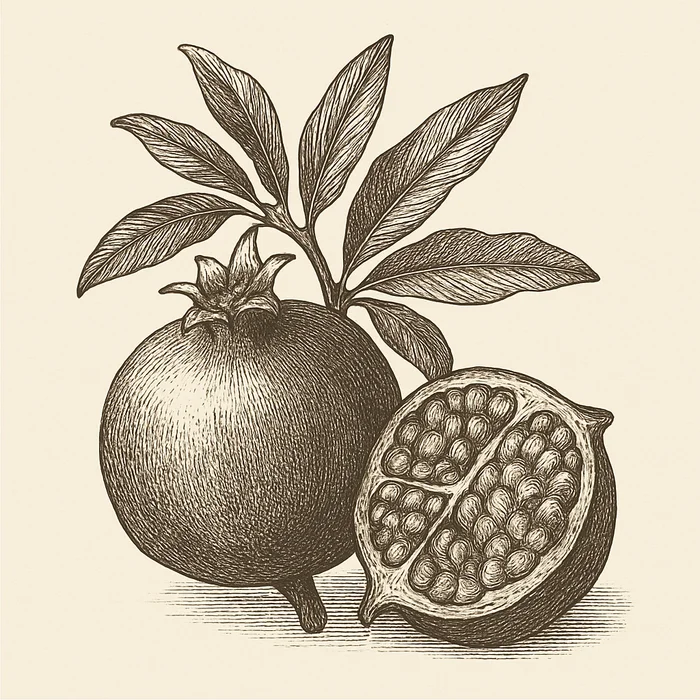
Pomegranate
The fruit that produces urolithin A — a gut bacterial metabolite so promising for mitochondrial health that it passed a Phase 1 human trial as a standalone anti-aging compound, and it comes free with every handful of arils.
Why It Matters for Longevity
Pomegranate's longevity case rests on punicalagins, a class of ellagitannins responsible for roughly 50% of the juice's remarkable antioxidant activity. The blood pressure evidence is solid: a meta-analysis of RCTs (Bahari et al., 2024) confirmed pomegranate consumption significantly reduces both systolic and diastolic blood pressure. The atherosclerosis data is even more striking: a 3-year clinical trial (Aviram et al., 2004) found pomegranate juice reduced carotid artery intima-media thickness and substantially cut oxidized LDL. Small trials have also suggested possible inhibition of prostate tumour growth — though this was not confirmed at scale in larger trials.
But the most significant pomegranate story for longevity is urolithin A.
Urolithin A: How It Works
When you eat pomegranate, gut bacteria convert its punicalagins into ellagic acid, then further into a family of compounds called urolithins. The key member, urolithin A, does something no other common dietary compound has demonstrated as clearly: it activates mitophagy — the cellular process of identifying and removing damaged mitochondria.
Mitochondria are the energy-producing organelles in every cell. As we age, damaged mitochondria accumulate rather than being cleared, contributing to the energy deficits and inflammation that drive multiple aging-related conditions. The landmark study by Ryu et al. (2016) in Nature Medicine established that urolithin A induces mitophagy, extends lifespan in C. elegans, and increases muscle function in older rodents — the first demonstration that a dietary compound could activate this pathway in animals.[4]
The most recent human evidence comes from Denk et al. (2025, Nature Aging): a randomized clinical trial in which urolithin A supplementation improved age-related immune decline in older adults, providing direct human evidence for this longevity pathway.[3]
Muscle Health & Physical Performance
One of the most practically relevant findings: urolithin A also appears to counteract sarcopenia — the age-related loss of muscle mass and strength. A randomized trial by Singh et al. (2022, Cell Reports Medicine) found that urolithin A supplementation for four months improved muscle strength, exercise performance, and biomarkers of mitochondrial health in middle-aged adults.[5] The effect size was modest but meaningful, and the mechanism aligns precisely with what mitophagy clearance would be expected to achieve in muscle tissue.
Are You a Urolithin Producer?
There is an important caveat: not everyone converts pomegranate polyphenols to urolithin A efficiently. Research has identified distinct human urolithin "metabotypes" — some people produce urolithin A readily, others produce primarily urolithin B (with weaker effects), and roughly a third produce neither in meaningful quantities. A 2023 study by Iglesias-Aguirre et al. identified the specific gut bacteria responsible for each step of ellagic acid metabolism to urolithins, explaining why individual response varies so dramatically.[6]
Eating pomegranate with fermented foods or yogurt may help cultivate the necessary bacterial populations over time, and regular long-term consumption appears to shift gut microbiome composition toward better conversion. Walnuts share the same ellagitannin-to-urolithin pathway, so pairing them — as in the Persian stew fesenjan — is both culinarily traditional and biochemically synergistic.
How to Use It
Eat fresh arils (seeds) for the most complete nutrient package — the seed itself contains punicic acid, a conjugated linolenic acid with anti-inflammatory properties. Drink pure pomegranate juice (not from concentrate, no added sugar) for concentrated punicalagins. Pomegranate molasses adds depth to salad dressings and marinades. Frozen arils are a convenient year-round option that retains most polyphenol content.
For maximum urolithin A potential: eat pomegranate alongside probiotic-rich foods and consistently, rather than occasionally. The gut bacteria that convert ellagitannins to urolithins are cultivated through repeated exposure.
Dosage
Human trials on urolithin A have used standardized supplements providing 500–2,000 mg of the compound directly, which circumvents the conversion variability issue. In food terms, the equivalent pomegranate exposure is harder to quantify precisely because urolithin A yield depends entirely on individual gut microbiome composition.
Practical targets from the research:
- Arils: 100–150g (about half a large pomegranate) several times per week
- Juice: 150–240ml of pure pomegranate juice daily, as used in the Aviram cardiovascular trial
- Frequency over quantity: consistent weekly consumption for several months appears more important than single large doses
If you are a poor urolithin converter (you can get tested via stool microbiome analysis), a myrosinase-active urolithin A supplement may be a more reliable route to the mitophagy benefits.
What to Pair It With
| Ingredient | Why | Tradition |
|---|---|---|
| Walnuts | Both produce urolithins via the same ellagitannin gut bacterial pathway | Persian (fesenjan) |
| Yogurt / labneh | Probiotics may enhance urolithin conversion over time | Middle Eastern |
| Dark leafy greens | Vitamin C from pomegranate aids iron absorption; polyphenol diversity | Mediterranean |
| Extra-virgin olive oil | Fat improves polyphenol absorption; classic vinaigrette base | Mediterranean |
| Dark chocolate | Complementary polyphenol profiles; additive antioxidant activity | Global |
Flavor Profile
Sweet-tart and bright with a wine-like astringency from the tannins. Each aril bursts with intensely coloured juice around a small, crunchy seed. The aroma is fruity and subtly floral with a faint berry-like muskiness. Pomegranate molasses concentrates the flavour into a syrupy, deeply tangy condiment. The balance of sweetness and astringency makes pomegranate a natural partner for both savoury and sweet dishes.
The Science
- Bahari et al., 2024, Phytother Res: Systematic review and meta-analysis of RCTs — pomegranate consumption significantly lowers systolic and diastolic blood pressure.
- Aviram et al., 2004, Clin Nutr: 3-year trial — pomegranate juice reduced carotid artery intima-media thickness and oxidized LDL in patients with carotid artery stenosis.
- Denk et al., 2025, Nature Aging: RCT — urolithin A supplementation improved age-related immune decline in older adults.
- Ryu et al., 2016, Nat Med: Landmark study — urolithin A induces mitophagy, extends C. elegans lifespan, and increases muscle function in rodents.
- Singh et al., 2022, Cell Rep Med: Human RCT — urolithin A improved muscle strength, exercise performance, and mitochondrial health biomarkers in middle-aged adults.
- Iglesias-Aguirre et al., 2023, J Agric Food Chem: Identified the specific gut bacteria responsible for each step of urolithin metabotype production — explaining why response to pomegranate varies so widely between individuals.
References
- Bahari H, Moodi M, Sharifan P, et al. The effects of pomegranate consumption on blood pressure in adults: A systematic review and meta-analysis of randomized clinical trials. Phytother Res. 2024;38(3):1622-1636. PMID: 38410857. doi:10.1002/ptr.8170
- Aviram M, Rosenblat M, Gaitini D, et al. Pomegranate juice consumption for 3 years by patients with carotid artery stenosis reduces common carotid intima-media thickness, blood pressure and LDL oxidation. Clin Nutr. 2004;23(3):423-433. PMID: 15158307. doi:10.1016/j.clnu.2003.10.002
- Denk D, Petrocca F, Zhu J, et al. Effect of the mitophagy inducer urolithin A on age-related immune decline: a randomized, placebo-controlled clinical trial. Nat Aging. 2025. PMID: 41174221. doi:10.1038/s43587-025-00996-x
- Ryu D, Mouchiroud L, Andreux PA, et al. Urolithin A induces mitophagy and prolongs lifespan in C. elegans and increases muscle function in rodents. Nat Med. 2016;22(8):879-888. PMID: 27400265. doi:10.1038/nm.4132
- Singh A, D'Amico D, Andreux PA, et al. Urolithin A improves muscle strength, exercise performance, and biomarkers of mitochondrial health in a randomized trial in middle-aged adults. Cell Rep Med. 2022;3(5):100633. PMID: 35584623. doi:10.1016/j.xcrm.2022.100633
- Iglesias-Aguirre CE, Cortés-Martín A, Selma MV, Espín JC. Gut Bacteria Involved in Ellagic Acid Metabolism To Yield Human Urolithin Metabotypes Revealed. J Agric Food Chem. 2023;71(9):4208-4219. PMID: 36840624. doi:10.1021/acs.jafc.2c08889
Key Nutrients
| Nutrient | Per 100g | Notes |
|---|---|---|
| Punicalagins | ~100–400 mg (juice) | ~50% of antioxidant activity; converted to urolithins by gut bacteria |
| Urolithin A | Gut metabolite | Induces mitophagy; yield varies by gut microbiome metabotype[6] |
| Anthocyanins | ~30–60 mg (arils) | Delphinidin + cyanidin; complementary to punicalagins |
| Vitamin C | 10.2 mg | Moderate; contributes to total antioxidant capacity |
| Potassium | 236 mg | Supports blood pressure benefits observed in trials[1] |