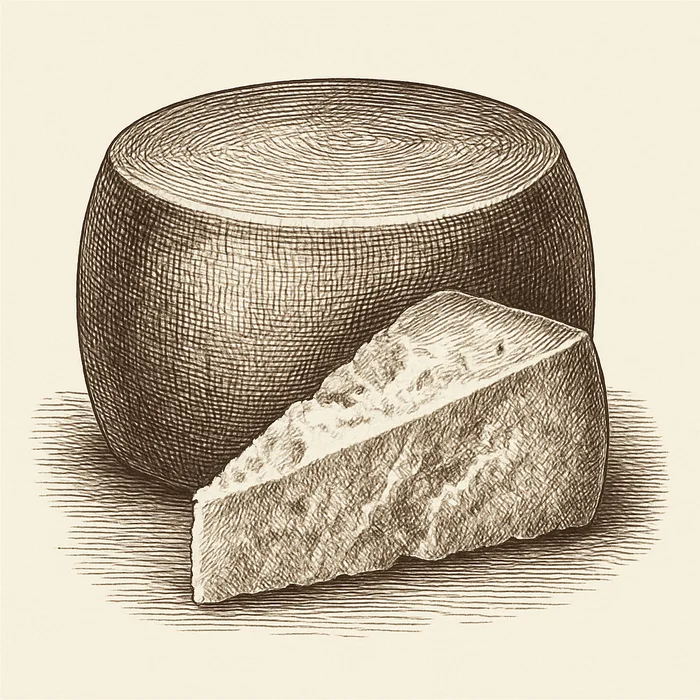
Parmesan Cheese
A small amount of aged Parmesan cheese (5 g, approximately 1 tbsp) is used as a finishing ingredient in several Longevity Diet pasta and vegetable dishes, adding intense umami flavor without excessive protein or saturated fat. Aged cheeses have concentrated glutamates, enabling significant flavor impact at very low serving sizes consistent with the diet's protein moderation goals.
Why It Matters for Longevity
The longevity case for small amounts of hard aged cheese rests on two bodies of evidence: population data showing dairy is not harmful at moderate intakes, and the connection between hard sheep and cow milk cheeses and the dietary patterns of long-lived Sardinian centenarians.
A large prospective cohort meta-analysis of 29 studies found that milk and dairy consumption — including cheese — was not associated with increased cardiovascular disease incidence or all-cause mortality; modest cheese consumption (up to approximately 40 g/day) showed a neutral-to-beneficial relationship with cardiovascular outcomes (Soedamah-Muthu et al., 2011, Am J Clin Nutr). This supports the Longevity Diet's use of small amounts of hard cheese as a flavoring agent rather than a primary protein source.
Epidemiological analysis of the Sardinian Blue Zone identified aged sheep and cow milk cheeses — including Pecorino and Parmesan-type cheeses — as regular components of the centenarian diet in a region characterized by an exceptional concentration of male centenarians, confirming that modest dairy in traditional fermented forms is compatible with extreme longevity (Poulain et al., 2004, Exp Gerontol).
Calcium, Protein, and Aging
At ~1,184 mg calcium per 100g, Parmesan is one of the most calcium-dense whole foods available. Even a 5g finishing amount delivers approximately 59 mg of calcium — about 6% of the daily value — in a highly bioavailable form because the cheese matrix contains no oxalates or phytates that compete for absorption. Calcium bioavailability from dairy is consistently around 30–35%, compared to 5–15% from oxalate-rich leafy greens such as spinach.
The protein in aged Parmesan (~35.7 g/100g) consists of extensively hydrolyzed casein and whey peptides. Extended aging (typically 24–36 months for Parmigiano-Reggiano) results in proteolysis that generates free amino acids and small bioactive peptides, including ACE-inhibitory peptides identified in aged cheese fractions. The protein digestibility-corrected amino acid score (PDCAAS) of isolated casein fractions approaches 1.0. At the 5g serving size, protein contribution is ~1.8g — consistent with the Longevity Diet's principle of using animal-derived ingredients for flavor and micronutrient density rather than as a primary protein source.
CLA and Lipid Profile
Aged cow milk cheeses contain conjugated linoleic acid (CLA), primarily the c9,t11 isomer (rumenic acid), produced from vaccenic acid via bacterial biohydrogenation in ruminant digestion. A randomized crossover trial by Pintus et al. (2013) in 42 adults with mild hypercholesterolemia found that consuming 90g/day of CLA-enriched sheep cheese for 3 weeks reduced LDL-cholesterol by approximately 7% and increased plasma CLA, vaccenic acid, and ALA, while the control cheese produced no measurable changes. Anandamide levels also decreased significantly, suggesting modulation of the endocannabinoid system alongside lipid effects. Pintus et al., 2013, Br J Nutr
This trial used enriched cheese at a 90g dose — far above the 5g culinary use of Parmesan. At typical finishing quantities, the CLA contribution is trace, approximately 0.01–0.05g. However, the trial establishes that dairy-derived CLA at achievable cheese-eating levels (the enriched cheese provided ~3g CLA/day) does not impair and may modestly improve lipid profiles, countering the assumption that saturated fat from aged cheese is unconditionally harmful.
Vitamin K2 in Aged Cheese: A Clarification
Parmesan is often cited as a source of vitamin K2, but direct measurement data suggest this is overstated. Vermeer et al. (2018) quantified menaquinone content across cheese varieties and found that Parmesan contained almost negligible amounts — approximately 3 ng/g — substantially less than Dutch-style hard cheeses such as Gouda, which can reach 656 ng/g at 13 weeks of aging. Vermeer et al., 2018, Nutrients
The difference appears to relate to the bacterial cultures used during fermentation: Lactococcus lactis and Propionibacterium freudenreichii (common in Dutch cheeses) produce long-chain menaquinones (MK-8, MK-9) efficiently, while the Lactobacillus-dominant cultures in Italian hard cheeses do not. Within the cheese category, Edam, Gouda, and certain other Northern European hard cheeses are more reliable K2 sources than Parmesan. For meaningful K2 intake at cooking-relevant quantities, natto (MK-7, ~1,000 mcg/100g) remains in a separate category entirely.
Cheese and Bone Markers: RCT Evidence
A randomized clinical trial by Lundberg et al. (2022) assigned 66 healthy women to 57g/day of Jarlsberg cheese (a Norwegian variety high in K2 MK-9) or 25–50g/day of Camembert for 6 weeks, then crossed the Camembert group to Jarlsberg. After 6 weeks of Jarlsberg consumption, procollagen type 1 N-terminal propeptide (PINP), total osteocalcin, carboxylated osteocalcin, osteocalcin carboxylation ratio, and serum vitamin K2 all increased significantly (p<0.01), while Camembert produced no comparable changes. Lundberg et al., 2022, BMJ Nutr Prev Health
This trial confirms two things relevant to cheese selection: first, the bone marker effects of cheese are K2-content-dependent rather than a general cheese effect; second, Parmesan's negligible K2 content means it should not be expected to replicate those outcomes. Parmesan's case for use in the Longevity Diet rests on its calcium density, umami concentration, and protein digestibility — not on K2.
Glutamate, Tyrosine, and the Umami Principle
Parmesan contains approximately 1.2g of free glutamate per 100g — among the highest natural concentrations of any food alongside sun-dried tomatoes (~0.64g/100g) and soy sauce (~1.1g/100g). Glutamate activates the umami taste receptor (T1R1/T1R3 heterodimer), which signals protein content to the brain and contributes to satiety. The tyrosine crystals visible in well-aged Parmesan are precipitates of the free amino acid tyrosine, released during proteolysis; they are a reliable visual marker of aging duration and correlate with glutamate concentration. This biochemistry means a 5g amount of finely grated Parmesan contains ~60 mg free glutamate — enough to perceptibly elevate the umami of a full pasta serving.
How to Use It
Use 5 g (approximately 1 tablespoon finely grated) as a finishing ingredient over pasta, risotto, or roasted vegetables. The intense umami from glutamates at this small quantity substantially elevates a dish's flavor without adding meaningful protein or saturated fat per the Longevity Diet's protein moderation principle.
What to Pair It With
| Ingredient | Why | Tradition |
|---|---|---|
| Pasta | The intense umami of 5 g Parmesan elevates an entire pasta dish with minimal protein | The Longevity Diet |
| Oyster mushrooms | Both are high-glutamate ingredients; stacking umami makes plant-forward dishes satisfying | Italian |
| Walnuts | Omega-3 ALA offsets the modest saturated fat contribution when paired in salads or pasta | Italian |
| Arugula | Classic Italian pairing; bitter greens balance the richness of Parmesan | Italian |
Flavor Profile
Sharp, umami, salty, nutty, with crystalline sweetness from tyrosine crystals in aged cheese. Aroma is pungent, fruity, and nutty. Texture is hard, granular, and finely powdery when grated. Category: aged hard cheese / condiment.
The Science
- Soedamah-Muthu et al., 2011, Am J Clin Nutr: Prospective cohort meta-analysis of dairy and cardiovascular outcomes — modest cheese consumption not associated with increased cardiovascular or all-cause mortality; neutral-to-beneficial relationship across 29 studies.
- Poulain et al., 2004, Exp Gerontol: AKEA study identifying Sardinian Blue Zone — epidemiological analysis confirming that aged sheep and cow milk cheeses are regular components of a centenarian diet characterized by exceptional male longevity.
- Pintus et al., 2013, Br J Nutr: RCT in 42 adults with mild hypercholesterolemia — 90g/day enriched sheep cheese (high CLA/vaccenic acid) for 3 weeks reduced LDL-cholesterol by ~7%; control cheese showed no effect; anandamide and leptin also decreased.
- Vermeer et al., 2018, Nutrients: Direct MK quantification across cheese varieties — Parmesan contained only ~3 ng/g menaquinones; Dutch hard cheeses (Gouda, Edam) up to 656 ng/g; K2 content in cheese is primarily a function of bacterial culture, not aging duration per se.
- Lundberg et al., 2022, BMJ Nutr Prev Health: RCT in 66 healthy women — 57g/day Jarlsberg cheese (high K2-MK-9) significantly increased PINP, total osteocalcin, carboxylated osteocalcin, and serum K2 vs Camembert over 6 weeks; effect was K2-content-dependent.
References
- Soedamah-Muthu SS, Ding EL, Al-Delaimy WK, et al. Milk and dairy consumption and incidence of cardiovascular diseases and all-cause mortality: dose-response meta-analysis of prospective cohort studies. Am J Clin Nutr. 2011;93(1):158-171. PMID: 21068345. doi:10.3945/ajcn.2010.29866
- Poulain M, Pes GM, Grasland C, et al. Identification of a geographic area characterized by extreme longevity in the Sardinia island: the AKEA study. Exp Gerontol. 2004;39(9):1423-1429. PMID: 15489066. doi:10.1016/j.exger.2004.06.016
- Pintus S, Murru E, Carta G, et al. Sheep cheese naturally enriched in α-linolenic, conjugated linoleic and vaccenic acids improves the lipid profile and reduces anandamide in the plasma of hypercholesterolaemic subjects. Br J Nutr. 2013;109(8):1453-62. PMID: 22917075. doi:10.1017/S0007114512003224
- Vermeer C, Raes J, van 't Hoofd C, Knapen MHJ, Xanthoulea S. Menaquinone Content of Cheese. Nutrients. 2018;10(4):446. PMID: 29617314. doi:10.3390/nu10040446
- Lundberg HE, Glasø M, Chhura R, et al. Effect on bone anabolic markers of daily cheese intake with and without vitamin K2: a randomised clinical trial. BMJ Nutr Prev Health. 2022;5(2):265-273. PMID: 36619332. doi:10.1136/bmjnph-2022-000424
Key Nutrients
| Nutrient | Per 100g | Notes |
|---|---|---|
| Calcium | ~1184 mg | Very high concentration; even 5 g provides ~59 mg (6% DV); highly bioavailable due to low oxalate matrix |
| Protein | ~35.7 g | Highly digestible whey and casein peptides formed during long aging; PDCAAS ~1.0 for isolated fractions |
| Glutamate (free) | ~1.2 g | One of the highest natural glutamate concentrations of any food; responsible for intense umami at very small doses |
| CLA (c9,t11 isomer) | ~0.3–0.5 g | Rumenic acid from ruminant digestion; at 90g/day doses in RCTs, reduces LDL ~7% and modulates endocannabinoids; trace at 5g culinary use |
| Vitamin K2 (MK-9) | ~3 ng/g (negligible) | Measured by Vermeer et al. 2018; substantially lower than Dutch hard cheeses; not a meaningful K2 source at culinary doses |