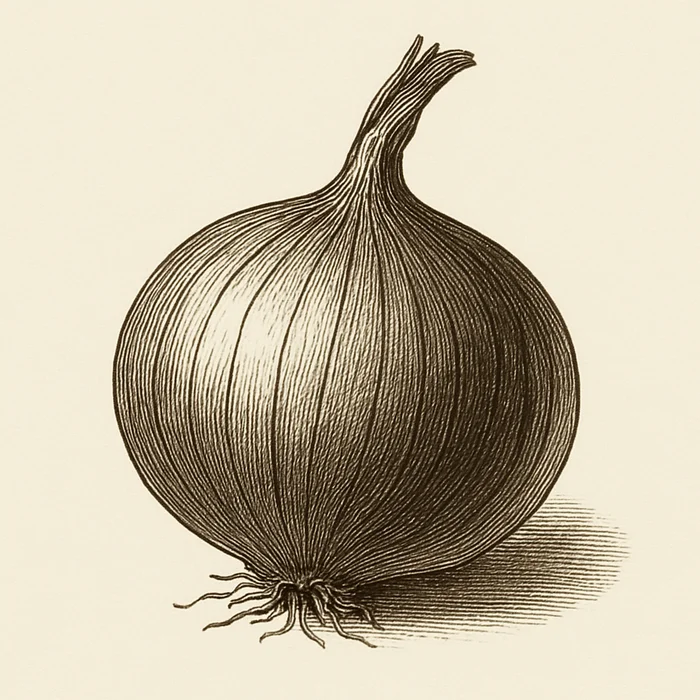
Onion
The invisible foundation of nearly every savory dish on earth, onion is also one of the richest dietary sources of quercetin -- a flavonoid that is better absorbed from the onion food matrix than from supplements, and whose epidemiological association with cancer protection is among the most consistent in allium vegetable research.
Why It Matters for Longevity
A meta-analysis of 16 case-control and cohort studies found that high allium vegetable consumption (onions, garlic, leeks, chives) was associated with a 41% reduction in gastric cancer risk and significant reductions in colorectal, esophageal, and prostate cancer risk, with a dose-response relationship supporting causality (Guercio et al., 2016, Mol Nutr Food Res).
Quercetin from onions is more bioavailable than from supplements due to the food matrix: onion quercetin glucosides are hydrolyzed in the small intestine with ~50% absorption efficiency, generating aglycone and methylated metabolites that reach tissues. A detailed review of quercetin bioavailability confirmed that onion is the optimal dietary delivery vehicle, with bioavailability significantly exceeding supplement forms and other foods (Terao et al., 2017, Biochem Pharmacol).
Red onions pack the most quercetin, plus anthocyanins and taxifolin. Ontario red onions demonstrated the strongest selective killing of colon and breast cancer cells in vitro compared with other onion varieties, explained by their high quercetin and anthocyanin content acting synergistically.
Onions also contain 2–6 g of fructooligosaccharides (FOS) per 100 g -- prebiotic fibers that selectively feed beneficial Bifidobacteria and Lactobacilli, contributing to gut microbiota diversity.
Quercetin and Blood Pressure
A systematic review and meta-analysis of seven randomized controlled trials (587 participants, 9 treatment arms) quantified quercetin's antihypertensive effect: supplementation reduced systolic blood pressure by -3.04 mmHg (95% CI: -5.75, -0.33; p=0.028) and diastolic blood pressure by -2.63 mmHg (95% CI: -3.26, -2.01; p<0.001) versus placebo. Dose matters substantially: trials using ≥500 mg/day showed a systolic reduction of -4.45 mmHg, while trials using lower doses showed no significant effect. Study duration ranged from 4 to 10 weeks (Serban et al., 2016, J Am Heart Assoc).
Quercetin's antihypertensive mechanism involves multiple vascular pathways. It inhibits angiotensin-converting enzyme (ACE), activates endothelial nitric oxide synthase (eNOS) to increase NO bioavailability, and reduces NADPH oxidase-derived superoxide that would otherwise scavenge NO. At the cellular level, quercetin modulates voltage-gated calcium channels and reduces sympathetic nervous system activity via AMPK activation in the hypothalamus.
For context, the 3-4 mmHg systolic reduction seen in the meta-analysis corresponds to an approximately 10% reduction in stroke risk and 7% reduction in coronary heart disease risk if sustained over time -- a meaningful contribution from a compound present at 20-50 mg per 100g in red onions and consumed daily in most diets.
Quercetin and Advanced Glycation End-Products
Advanced glycation end-products (AGEs) form when reducing sugars react non-enzymatically with proteins and lipids -- a process accelerated in diabetes and metabolic syndrome. Accumulated AGEs crosslink collagen, impair kidney filtration, drive vascular inflammation via RAGE receptor signaling, and are associated with accelerated biological aging.
Quercetin inhibits AGE formation through three complementary mechanisms: metal ion chelation (blocking transition metal-catalyzed Maillard reactions), trapping of reactive dicarbonyl intermediates such as methylglyoxal (MGO) and glyoxal before they can form adducts, and scavenging of the reactive oxygen species that accelerate glycation chemistry.
The human RCT evidence is specific: a double-blind, placebo-controlled crossover trial in 37 adults with prehypertension found that quercetin at 160 mg/day for four weeks decreased plasma methylglyoxal concentration by 40.2 nmol/L (95% CI: -73.6, -6.8; p=0.019), representing an 11% reduction from baseline. Epicatechin at 100 mg/day, tested in parallel arms, showed no significant effect on MGO, suggesting a quercetin-specific mechanism (Van den Eynde et al., 2018, J Nutr). The dose used (160 mg quercetin as quercetin-3-glucoside) is achievable from approximately 300-400g of yellow onions or 150g of red onions daily -- substantial but not unrealistic in a diet where onion is a regular cooking base.
Quercetin from Whole Onion vs. Supplements
The blood pressure and AGE-inhibition evidence cited above used isolated quercetin supplements at doses of 160–500 mg/day. An important parallel question is whether food-matrix quercetin from actual onions produces equivalent effects at realistic dietary quantities. A crossover RCT in 68 overweight-to-obese adults with prehypertension or stage-1 hypertension tested 162 mg/day quercetin delivered as onion skin extract powder (rather than isolated quercetin) for six weeks. In the prespecified subgroup of participants with established hypertension (n=31), 24-hour ambulatory systolic blood pressure fell by −3.6 mmHg (p=0.022) versus placebo; the effect in the full prehypertensive group was non-significant (Brüll et al., 2015, Br J Nutr). The dose of 162 mg quercetin from onion skin corresponds roughly to eating 300–500g of raw yellow onion or 150–200g of red onion daily -- achievable in a diet where onion is used as a consistent cooking base, though toward the high end of typical intake.
The finding that the blood pressure response was confined to the hypertensive subgroup is consistent with the biological logic: quercetin's antihypertensive mechanisms (ACE inhibition, eNOS activation, NADPH oxidase suppression) provide the greatest absolute benefit when vascular tone is already dysregulated. In normotensive individuals the same pathway operates but the starting blood pressure leaves less room for measurable reduction.
Prebiotic Fructooligosaccharides and Gut Microbiota
Onions contain 2–6 g of fructooligosaccharides (FOS) per 100 g fresh weight, making them among the richest vegetable FOS sources alongside garlic and Jerusalem artichoke. FOS are short-chain fructans that resist small-intestinal digestion and arrive intact in the colon, where they serve as a selective substrate for Bifidobacterium species that possess the β-fructosidase enzyme for their fermentation. The selectivity matters: Bifidobacteria ferment FOS to acetate, lactate, and short-chain fatty acids without generating the branched-chain amino acid fermentation products (which produce potentially harmful metabolites) characteristic of other bacteria.
A systematic review and meta-analysis of 8 randomized controlled trials (213 participants receiving FOS, 175 controls) found that FOS supplementation significantly increased Bifidobacterium counts (effect size 0.579, 95% CI: 0.444–0.714), with stronger effects at doses above 5 g/day (effect size 1.116, 95% CI: 0.685–1.546) and at interventions lasting more than four weeks (effect size 0.841, 95% CI: 0.436–1.247). No significant differences in gastrointestinal adverse events were observed between FOS and placebo arms (Dou et al., 2022, Nutrients).
The practical implication is that onion's prebiotic contribution is real but dose-dependent. At typical culinary amounts (50–100g per meal), onion provides 1–6 g FOS, which is below the threshold for dramatic microbiome shifts but contributes meaningfully when consumed daily across multiple meals. The combination of prebiotic FOS with onion's antimicrobial thiosulfinates is not contradictory: the thiosulfinates are largely metabolized before reaching the colon, while FOS arrive intact to feed colonic Bifidobacteria.
Thiosulfinates and Allicin Precursors
When onion cells are cut, the enzyme alliinase converts isoalliin into trans-1-propenyl-L-cysteine sulfoxide, which spontaneously forms the thiosulfinates responsible for the sharp, tear-inducing aroma. These sulfur compounds are distinct from garlic's allicin (which requires S-allylcysteine as substrate) but share the general H2S-releasing chemistry. Hydrogen sulfide acts as a gasotransmitter with vasodilatory effects via KATP channel activation in vascular smooth muscle. This provides an additional cardiovascular mechanism alongside quercetin's NO pathway.
Thiosulfinates are volatile and destroyed by prolonged heat. For maximum bioactive content, raw onion -- particularly in salads, salsas, and quick pickles -- preserves both the thiosulfinates and the intact quercetin glucosides. The tradeoff is palatability: cooking converts the sharp thiosulfinates to disulfides and polysulfides with a sweeter, less pungent character, while slow caramelization generates Maillard reaction products with their own distinct flavour complexity.
How to Use It
Raw for maximum thiosulfinates (the antimicrobial sulfur compounds formed on cutting). Caramelized slowly for deep sweetness. Red onions in salads and salsas for maximum quercetin and anthocyanins. Yellow onions for the cooking base. Prolonged cooking destroys thiosulfinates but retains quercetin. For the AGE-inhibition benefit, the relevant daily target (~150-300g red onion or equivalent) fits naturally into a diet where onion is used as a consistent aromatic base across multiple meals.
What to Pair It With
| Ingredient | Why | Tradition |
|---|---|---|
| Garlic | Fellow alliums; foundational aromatic duo | Global |
| Extra-virgin olive oil | Fat enhances quercetin absorption; base for soffritto | Mediterranean |
| Tomatoes | Complementary flavonoids; base for sauces and curries | Mediterranean / Indian |
| Balsamic vinegar | Acid and sweet balance onion's pungency | Italian (agrodolce) |
| Lentils | Onion is the base of all dal and lentil soups | Indian / Middle Eastern |
| Thyme | Deepens caramelized onion flavor | French (onion soup) |
Flavor Profile
Raw: pungent, sharp, tear-inducing. Caramelized: rich, sweet, silky. Crisp and crunchy raw; melting and soft when slow-cooked. The transformation from raw to cooked onion is one of the greatest tricks in the kitchen.
The Science
- Guercio et al., 2016, Mol Nutr Food Res: Meta-analysis of 16 studies -- high allium vegetable consumption associated with 41% reduced gastric cancer risk and significant reductions in colorectal, esophageal, and prostate cancer risk with a dose-response relationship.
- Terao et al., 2017, Biochem Pharmacol: Review of quercetin bioavailability -- onion quercetin glucosides achieve ~50% absorption efficiency via small intestinal hydrolysis, significantly exceeding supplement forms; confirms onion as the optimal dietary quercetin source.
- Serban et al., 2016, J Am Heart Assoc: Meta-analysis of 7 RCTs (n=587) -- quercetin supplementation reduced systolic BP by -3.04 mmHg (p=0.028) and diastolic BP by -2.63 mmHg (p<0.001); effect confined to doses ≥500 mg/day.
- Van den Eynde et al., 2018, J Nutr: Crossover RCT (n=37) -- quercetin at 160 mg/day for 4 weeks reduced plasma methylglyoxal by 40.2 nmol/L (11%; p=0.019); epicatechin showed no effect, indicating a quercetin-specific AGE-inhibition mechanism.
- Brüll et al., 2015, Br J Nutr: Crossover RCT (n=68) -- 162 mg/day quercetin from onion skin extract for 6 weeks reduced 24h ambulatory systolic BP by −3.6 mmHg (p=0.022) in hypertensive subgroup (n=31); effect absent in pre-hypertensives.
- Dou et al., 2022, Nutrients: Meta-analysis of 8 RCTs (n=388) -- FOS supplementation significantly increased Bifidobacterium (effect size 0.579; 95% CI: 0.444–0.714); effects larger at doses >5 g/day and interventions >4 weeks; no significant GI adverse events.
References
- Guercio V, Galeone C, Turati F, La Vecchia C. Gastric cancer and allium vegetable intake: a critical review of the experimental and epidemiologic evidence. Mol Nutr Food Res. 2016;60(3):556-565. PMID: 26464065. doi:10.1002/mnfr.201500452
- Terao J, Murota K, Kawai Y. Conjugated quercetin glucuronides as bioactive metabolites and precursors of aglycone in vivo. Biochem Pharmacol. 2017;139:71-78. PMID: 28377278. doi:10.1016/j.bcp.2017.03.021
- Serban MC, Sahebkar A, Zanchetti A, et al. Effects of quercetin on blood pressure: a systematic review and meta-analysis of randomized controlled trials. J Am Heart Assoc. 2016;5(7):e002713. PMID: 27405810. doi:10.1161/JAHA.115.002713
- Van den Eynde MDG, Geleijnse JM, Scheijen JLJM, et al. Quercetin, but not epicatechin, decreases plasma concentrations of methylglyoxal in adults in a randomized, double-blind, placebo-controlled, crossover trial with pure flavonoids. J Nutr. 2018;148(12):1911-1916. PMID: 30398646. doi:10.1093/jn/nxy236
- Brüll V, Burak C, Stoffel-Wagner B, et al. Effects of a quercetin-rich onion skin extract on 24 h ambulatory blood pressure and endothelial function in overweight-to-obese patients with (pre-)hypertension: a randomised double-blinded placebo-controlled cross-over trial. Br J Nutr. 2015;114(8):1263-1277. PMID: 26328470. doi:10.1017/S0007114515002950
- Dou Y, Yu X, Luo Y, Chen B, Ma D, Zhu J. Effect of fructooligosaccharides supplementation on the gut microbiota in human: a systematic review and meta-analysis. Nutrients. 2022;14(16):3298. PMID: 36014803. doi:10.3390/nu14163298
Key Nutrients
| Nutrient | Per 100g | Notes |
|---|---|---|
| Quercetin | 20–50 mg (red), 10–20 mg (yellow) | ~50% absorbed from onion matrix via small intestinal hydrolysis of glucosides; significantly higher bioavailability than supplements |
| Fructooligosaccharides | 2–6 g | Prebiotic; feeds Bifidobacteria and Lactobacilli |
| Anthocyanins | 25–50 mg (red only) | Low absolute bioavailability but gut metabolites are bioactive |
| Thiosulfinates | Variable (formed on cutting) | H2S-releasing; vasodilatory via KATP channel activation; destroyed by prolonged cooking |