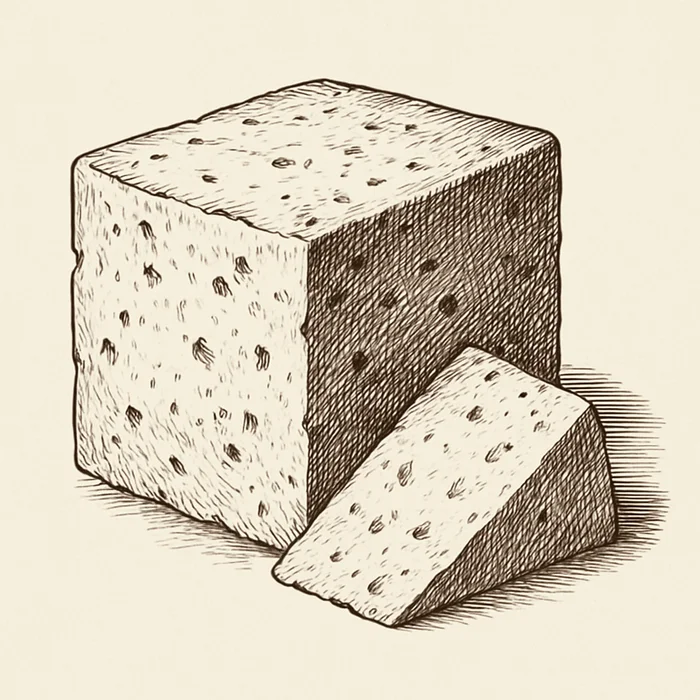
Feta Cheese
Feta (preferably from goat's or sheep's milk) is one of the few animal-derived foods recommended in the Longevity Diet, especially for those over 65. Used in small amounts in the grilled eggplant dish and Greek salad — about 20 g per dish — as a source of calcium and flavor.
Why It Matters for Longevity
Goat and sheep milk cheeses have a distinct fatty acid composition compared to cow milk products: higher proportions of medium-chain fatty acids and conjugated linoleic acid (CLA), lower αs1-casein (potentially reducing allergenicity), and smaller fat globules that may improve digestibility. Feta's fermentation process reduces lactose content and produces bioactive peptides with ACE-inhibitory properties.
Hard and semi-hard cheeses from cow, sheep, and goat milk differ significantly in fatty acid composition; sheep and goat cheeses contain more medium-chain fatty acids and omega-3 PUFAs than cow cheese, with lipid quality indices (atherogenicity, thrombogenicity) generally more favorable in small-ruminant cheeses (Paszczyk et al., 2020, Foods).
Fermented dairy products including cheese provide probiotic cultures, bioactive peptides, and vitamin K2 that support cardiometabolic health; prospective cohort data consistently show fermented dairy intake associated with reduced cardiovascular disease risk and all-cause mortality (Companys et al., 2020, Adv Nutr).
Calcium, Bone Density, and Aging
Feta provides approximately 493 mg of calcium per 100g — among the highest concentrations in common foods. At the 20 g serving size used in the Longevity Diet, this delivers ~99 mg, roughly 10% of the recommended daily intake, in a portion that also contributes protein, fat, and micronutrients that support absorption.
Calcium bioavailability from fermented dairy products is estimated at approximately 32% — comparable to milk and higher than most plant-based calcium sources (spinach: ~5%, due to oxalate binding). Fermentation may improve calcium bioavailability by reducing phytate content and producing lactate, which forms more soluble calcium salts in the gut. The clinical relevance is clear: a meta-analysis of 6 RCTs involving 618 postmenopausal women found that dairy product consumption significantly increased bone mineral density at the lumbar spine (SMD 0.21), femoral neck (SMD 0.36), total hip (SMD 0.37), and total body (SMD 0.58), with benefits emerging from 12 months of consistent intake (Shi et al., 2020, Arch Osteoporos). These were general dairy RCTs, not feta-specific, but feta's calcium and protein content places it within the same mechanistic framework.
The skeletal relevance is heightened in older adults: after 65, net bone resorption exceeds formation and adequate calcium intake is one of the modifiable factors that slows this trajectory. Protein co-ingestion with calcium further improves bone outcomes by stimulating IGF-1 and supporting osteoblast activity.
ACE-Inhibitory Peptides and Blood Pressure
During cheese ripening, lactic acid bacteria proteolyse casein into thousands of peptides. Among these, several tripeptides — including Val-Pro-Pro and Ile-Pro-Pro — inhibit angiotensin-converting enzyme (ACE), the enzyme that converts angiotensin I to the vasoconstricting angiotensin II. ACE inhibition reduces peripheral vascular resistance, producing blood pressure-lowering effects through the same pathway as pharmaceutical ACE inhibitor drugs, though at far smaller magnitudes from food. The peptide profile in feta depends on the specific bacterial strains used in fermentation, ageing duration, and milk source. Sheep and goat milk casein hydrolyses somewhat differently from bovine casein, and some evidence suggests more bioactive peptide generation from small-ruminant fermentation. Direct clinical trials measuring the blood pressure effect of feta specifically have not been published; the mechanism is established from fermented dairy broadly, with the antihypertensive activity of these peptides confirmed in the fermented dairy literature (Takano, 2002, Antonie Van Leeuwenhoek).
CLA: What the Evidence Actually Shows
Conjugated linoleic acid in feta ranges from approximately 0.4 to 0.9 g per 100g, with higher concentrations in pasture-fed sheep-milk feta. CLA is a mixture of positional and geometric isomers of linoleic acid; the predominant dietary form is c9,t11-CLA (rumenic acid), produced by bacterial biohydrogenation in ruminant digestive tracts.
The body composition evidence for CLA is modest and inconsistent. A dose-response meta-analysis of 70 RCTs across 4,159 participants found that CLA supplementation produced statistically significant but clinically small reductions in body mass (–0.35 kg), BMI (–0.15), waist circumference (–0.62 cm), and fat mass (–0.44 kg), alongside a small increase in fat-free mass (+0.27 kg) (Asbaghi et al., 2024, Br J Nutr). High-quality subgroup analysis found that the fat-reducing effect disappeared — only the fat-free mass increase and modest weight reduction held. These studies used supplemental CLA doses (3–6 g/day), far above what 20 g of feta delivers (~0.08–0.18 g CLA).
The inflammation picture is more cautionary. A separate meta-analysis of 11 RCTs in 420 participants found that CLA supplementation increased CRP by 0.89 mg/L (95% CI 0.11–1.68; P = 0.025) and TNF-α by 0.39 pg/mL (95% CI 0.23–0.55; P < 0.001) (Haghighatdoost & Nobakht, 2018, Eur J Clin Nutr). This signal applies to high-dose supplemental CLA; the small amounts in feta are unlikely to produce measurable inflammatory effects. The practical implication: feta's CLA content is not a therapeutic dose, but the food-matrix CLA from traditional dairy is not equivalent pharmacologically to isolated CLA supplements.
Vitamin K2 and Vascular Calcification
Cheese is one of the better dietary sources of vitamin K2 (menaquinone), primarily in the MK-4 form, with some fermented varieties also producing longer-chain menaquinones. Vitamin K2 functions as a cofactor for the gamma-carboxylation of matrix Gla protein (MGP), which in its carboxylated form inhibits vascular and soft-tissue calcification by sequestering calcium ions and suppressing osteogenic transcription factors in vascular smooth muscle cells (El Asmar et al., 2014, Oman Med J). Undercarboxylated MGP — a marker of vitamin K2 insufficiency — is elevated in populations with higher rates of arterial stiffness and coronary calcification. Prospective cohort data associate higher dietary K2 intake with reduced coronary artery disease incidence, though no adequately powered RCT has yet demonstrated mortality reduction from K2 supplementation. The food-matrix contribution from feta remains modest relative to natto, but within a Mediterranean diet that is low in dedicated K2 sources, regular feta consumption is a practical contributor.
How to Use It
Use 20 g crumbled on grilled eggplant or in Greek salad as in the Longevity Diet prescriptions. Pair with tomatoes, olives, and olive oil. Choose authentic Greek feta (PDO) made from sheep's milk or a blend with goat's milk for the best fatty acid profile.
What to Pair It With
| Ingredient | Why | Tradition |
|---|---|---|
| Tomatoes | Lycopene is fat-soluble, better absorbed with feta's fat; vitamin C complements calcium | Mediterranean |
| Olives | Polyphenols in olives complement feta; classic Greek salad combination | Greek/Mediterranean |
| Eggplant | Longevity Diet prescription; complementary textures and flavors | The Longevity Diet |
| Extra-virgin olive oil | Classic drizzle preparation; monounsaturated fats support anti-inflammatory effects | Mediterranean |
Flavor Profile
Tangy, salty, milky, slightly acidic, creamy. Aroma is milky, lactic, slightly barn-like in sheep/goat varieties. Texture is crumbly, creamy, dense. Traditional Greek feta aged in brine develops sharper, more complex flavor than mass-produced varieties.
The Science
- Paszczyk et al., 2020, Foods: Comparison of fatty acid composition in hard cow, sheep, and goat cheese found sheep and goat varieties contain more medium-chain fatty acids and omega-3 PUFAs, with more favorable lipid quality indices.
- Companys et al., 2020, Adv Nutr: Systematic review found fermented dairy associated with reduced cardiometabolic disease risk; fermentation generates bioactive peptides and delivers probiotic bacteria supporting metabolic health.
- Shi et al., 2020, Arch Osteoporos: Meta-analysis (6 RCTs, 618 postmenopausal women) — dairy consumption significantly increased bone mineral density at femoral neck (SMD 0.36) and total hip (SMD 0.37), with benefits emerging from 12 months of intake.
- Asbaghi et al., 2024, Br J Nutr: Dose-response meta-analysis (70 RCTs, 4,159 participants) — supplemental CLA produced small reductions in fat mass (–0.44 kg) and increases in fat-free mass (+0.27 kg); effects clinically modest, and high-quality evidence did not support fat-mass reduction.
- Haghighatdoost & Nobakht, 2018, Eur J Clin Nutr: Meta-analysis (11 RCTs, 420 participants) — high-dose supplemental CLA increased CRP by 0.89 mg/L and TNF-α by 0.39 pg/mL; pro-inflammatory signal at supplemental doses not applicable to food-matrix amounts.
- El Asmar et al., 2014, Oman Med J: Vitamin K2 enables gamma-carboxylation of matrix Gla protein; activated MGP inhibits vascular calcification by sequestering calcium and suppressing osteogenic signals in vessel walls.
- Takano, 2002, Antonie Van Leeuwenhoek: Fermented dairy ACE-inhibitory peptides (produced by Lactobacillus helveticus) lower blood pressure via the renin-angiotensin system; active without requiring live bacteria in the final product.
References
- Paszczyk B, Łuczyńska J. The Comparison of Fatty Acid Composition and Lipid Quality Indices in Hard Cow, Sheep, and Goat Cheeses. Foods. 2020;9(11):1667. PMID: 33203107. doi:10.3390/foods9111667
- Companys J, Pla-Pagà L, Calderón-Pérez L, et al. Fermented Dairy Products, Probiotic Supplementation, and Cardiometabolic Diseases: A Systematic Review and Meta-Analysis. Adv Nutr. 2020;11(4):834-863. PMID: 32277831. doi:10.1093/advances/nmaa030
- Shi Y, Zhan Y, Chen Y, Jiang Y. Effects of dairy products on bone mineral density in healthy postmenopausal women: a systematic review and meta-analysis of randomized controlled trials. Arch Osteoporos. 2020;15(1):48. PMID: 32185512. doi:10.1007/s11657-020-0684-0
- Asbaghi O, Shimi G, Hosseini Oskouie F, et al. The effects of conjugated linoleic acid supplementation on anthropometrics and body composition indices in adults: a systematic review and dose-response meta-analysis. Br J Nutr. 2024;131(3):376-390. PMID: 37671495. doi:10.1017/S0007114523002143
- Haghighatdoost F, Nobakht M Gh BF. Effect of conjugated linoleic acid on blood inflammatory markers: a systematic review and meta-analysis on randomized controlled trials. Eur J Clin Nutr. 2018;72(8):1071-1082. PMID: 29288248. doi:10.1038/s41430-017-0048-z
- El Asmar MS, Naoum JJ, Arbid EJ. Vitamin k dependent proteins and the role of vitamin k2 in the modulation of vascular calcification: a review. Oman Med J. 2014;29(3):172-177. PMID: 24936265. doi:10.5001/omj.2014.44
- Takano T. Anti-hypertensive activity of fermented dairy products containing biogenic peptides. Antonie Van Leeuwenhoek. 2002;82(1-4):333-40. PMID: 12369200. doi:10.1023/a:1020698516798
Key Nutrients
| Nutrient | Per 100g | Notes |
|---|---|---|
| Calcium | 493 mg | Highly bioavailable (~32%); fermented cheese calcium may be better absorbed than milk calcium |
| Protein | 14 g | Complete protein; casein-dominant, slow-digesting; supports muscle maintenance in older adults |
| Conjugated Linoleic Acid (CLA) | 0.4–0.9 g | Higher in pasture-fed sheep/goat feta; food-matrix CLA not equivalent to supplemental doses |
| Vitamin B12 | 1.69 mcg | Animal-sourced B12; highly bioavailable |
| Vitamin K2 (MK-4) | ~0.5–2 mcg | Activates matrix Gla protein for vascular calcification inhibition; content varies by fermentation |