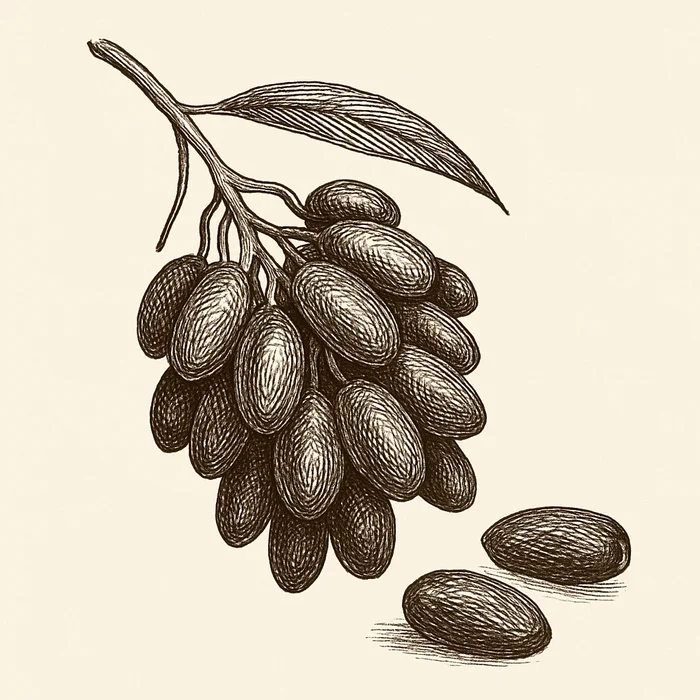
Dates
The world's oldest cultivated fruit looks like pure sugar on paper -- 66g per 100g -- yet its glycaemic index lands between 42 and 55, lower than white bread, thanks to a fibre matrix that slows absorption.
Why It Matters for Longevity
Dates occupy a nuanced position in longevity nutrition. Fontana mentions them in the context of Ramadan fasting, where a few dates at dusk provide quick glucose replenishment after an extended fast without a large caloric load. This cultural practice aligns with modern time-restricted eating research, and dates serve as an elegant fast-breaking food -- concentrated energy in a small, fibre-rich package.
The surprising finding is their glycaemic behaviour. Despite sugar content rivalling candy, dates register a GI of 42-55 depending on variety (Alkaabi et al., 2011). The explanation lies in their fibre (6.7g per 100g), their fructose-to-glucose ratio, and their intact food matrix. An RCT (Rock et al., 2009) confirmed that date consumption did not adversely affect blood glucose or lipid profiles in healthy individuals. This does not make them a free food -- calories are real -- but it means they behave very differently from refined sugar in the body.
Dates also deliver a meaningful antioxidant payload. Reviews of their phytochemistry (Vayalil, 2012) found high concentrations of phenolic acids -- ferulic, caffeic, and protocatechuic acid -- with antioxidant capacity comparable to some berries. Darker varieties tend to score higher. The anti-inflammatory and anti-tumour properties have been demonstrated in vitro, though human intervention data is limited.
Phenolic acid profile in detail. Analytical profiling of Omani cultivars measured p-coumaric acid at 21–25 mg per 100 g and total phenolics at 104–164 mg gallic acid equivalents per 100 g, with darker Umsellah dates scoring ~58% higher total phenolics than lighter Khalas dates. Tannin content reached 73.65 mg catechin equivalents per 100 g. These compounds -- particularly p-coumaric and ferulic acids -- function as hydrogen-atom donors that neutralise reactive oxygen species before they can damage DNA or oxidise LDL particles (Siddiqi et al., 2020, Sci Total Environ).
Gut microbiome and colon health. A randomised controlled cross-over trial assigned 22 healthy adults to eat seven dates (~50 g) daily for 21 days with a 14-day washout. Date consumption produced significant increases in bowel movement frequency (p < 0.01), significant reductions in stool ammonia concentration (p < 0.05) -- a nitrogen-waste marker linked to colonic carcinogenesis -- and a significant reduction in the genotoxicity of faecal water (p < 0.01), without requiring measurable shifts in gut bacterial populations. The researchers attributed these effects to the combined action of insoluble fibre (which accelerates transit and dilutes carcinogens) and date polyphenols (which act directly on colonocytes) (Eid et al., 2015, Br J Nutr). A companion in vitro study using pH-controlled batch cultures of human faecal microbiota found that date extract increased bifidobacteria at 5 hours (p < 0.05), elevated acetate production at 48 hours, and inhibited Caco-2 colon cancer cell proliferation by approximately 90% at 48 hours (Eid et al., 2014, J Nutr Sci). The in vitro data requires cautious interpretation -- cell culture results do not translate directly to human risk -- but the mechanistic picture they paint is consistent with the microbiome RCT findings.
From a mineral standpoint, dates are potassium powerhouses: 696mg per 100g, making them one of the richest fruit sources. This is clinically relevant for blood pressure regulation, particularly in populations eating high-sodium diets. They also contribute meaningful magnesium (54mg per 100g).
The strategic use of dates is as a whole-food sweetener. Replacing refined sugar with date paste or whole chopped dates in baking, oatmeal, or energy balls preserves the fibre matrix and delivers minerals and polyphenols alongside the sweetness. Pairing dates with nuts or tahini further moderates their glycaemic impact by adding fat and protein.
How to Use It
Two to three Medjool dates (about 50-70g) make a satisfying snack or fast-breaking food. Stuff with walnuts or almonds for a balanced treat. Blend into smoothies as a natural sweetener. Use date paste instead of sugar in baking. Chop into oatmeal or yogurt. Keep portions moderate -- they are calorie-dense at about 280 kcal per 100g. Always pair with protein or fat to blunt the glucose curve.
What to Pair It With
| Ingredient | Why | Tradition |
|---|---|---|
| Walnuts / almonds | Protein + fat slow glucose absorption; complete snack | Middle Eastern |
| Tahini | Sesamin + healthy fats complement date minerals | Middle Eastern |
| Dark chocolate | Complementary polyphenol profiles; indulgent but functional | Global |
| Cinnamon | Insulin-sensitising properties moderate glycaemic response | Middle Eastern / North African |
| Yogurt | Protein + probiotics balance the sugar load | Middle Eastern |
Flavor Profile
Intensely sweet with layers of caramel, butterscotch, and honey. Medjool dates are fudge-like and sticky, while Deglet Noor are drier and more subtle, with a nutty undertone. The aroma is warm and molasses-rich with hints of toffee. The dense, chewy texture makes them deeply satisfying in small quantities. Overripe dates develop a slightly fermented, rum-like complexity.
The Science
- Alkaabi et al., 2011, Nutr J: Five varieties of dates had glycaemic indices of 42--55 in both healthy and diabetic subjects -- substantially lower than refined sugar and white bread, driven by the fibre matrix and fructose:glucose ratio.
- Vayalil, 2012, Crit Rev Food Sci Nutr: Comprehensive review of date fruit phytochemistry -- high polyphenol content (ferulic, caffeic, protocatechuic acid) with antioxidant, anti-inflammatory, and anti-tumour properties; phenolic acids comparable in potency to some berries; dates also provide significant potassium (696 mg/100g) and magnesium (54 mg/100g).
- Siddiqi et al., 2020, Sci Total Environ: Comparative analysis of two Omani date cultivars -- p-coumaric acid 21--25 mg/100 g; total phenolics 104--164 mg GAE/100 g; tannins 73.65 mg catechin equivalents/100 g; darker variety scored 58% higher total phenolics. Antioxidant activity supports functional food classification for metabolic health.
- Eid et al., 2015, Br J Nutr: Randomised, controlled, cross-over trial in 22 healthy adults consuming 7 dates/day for 21 days -- significant increase in bowel movement frequency (p < 0.01), significant reduction in stool ammonia (p < 0.05), and significant reduction in faecal water genotoxicity (p < 0.01). Combined fibre + polyphenol mechanism.
- Eid et al., 2014, J Nutr Sci: In vitro fermentation study with human faecal microbiota -- date extract increased bifidobacteria at 5 h (p < 0.05), raised acetate at 48 h, and inhibited Caco-2 colon cancer cell proliferation by ~90% at 48 h.
- Aune et al., 2017, Int J Epidemiol: Meta-analysis of 95 prospective studies -- total fruit intake (including low-GI whole fruits like dates) associated with dose-dependent reductions in cardiovascular disease, cancer, and all-cause mortality.
References
- Alkaabi JM, Al-Dabbagh B, Ahmad S, Saadi HF, Gariballa S, Al Ghazali M. Glycemic indices of five varieties of dates in healthy and diabetic subjects. Nutr J. 2011;10:59. PMID: 21619670. doi:10.1186/1475-2891-10-59
- Vayalil PK. Date fruits (Phoenix dactylifera Linn): an emerging medicinal food. Crit Rev Food Sci Nutr. 2012;52(3):249-271. PMID: 22214443. doi:10.1080/10408398.2010.529829
- Siddiqi SA, Rahman S, Khan MM, et al. Potential of dates (Phoenix dactylifera L.) as natural antioxidant source and functional food for healthy diet. Sci Total Environ. 2020;748:141234. PMID: 32798862. doi:10.1016/j.scitotenv.2020.141234
- Eid N, Osmanova H, Natchez C, et al. Impact of palm date consumption on microbiota growth and large intestinal health: a randomised, controlled, cross-over, human intervention study. Br J Nutr. 2015;114(8):1226-1236. PMID: 26428278. doi:10.1017/S0007114515002780
- Eid N, Enani S, Walton G, et al. The impact of date palm fruits and their component polyphenols, on gut microbial ecology, bacterial metabolites and colon cancer cell proliferation. J Nutr Sci. 2014;3:e59. PMID: 26101614. doi:10.1017/jns.2014.52
- Aune D, Giovannucci E, Boffetta P, et al. Fruit and vegetable intake and the risk of cardiovascular disease, total cancer and all-cause mortality -- a systematic review and dose-response meta-analysis of prospective studies. Int J Epidemiol. 2017;46(3):1029-1056. PMID: 28338764. doi:10.1093/ije/dyw319
Key Nutrients
| Nutrient | Per 100g | Notes |
|---|---|---|
| Potassium | 696 mg (15% DV) | One of richest fruit sources; supports blood pressure regulation |
| Dietary fibre | 6.7 g | Key to unexpectedly low glycaemic index despite high sugar |
| Phenolic acids | ~100-500 mg GAE | Ferulic, caffeic, protocatechuic; darker varieties higher |
| Magnesium | 54 mg (13% DV) | Supports glucose metabolism and muscle function |
| Natural sugars | ~66 g | GI 42-55; lower than white bread despite high sugar content |