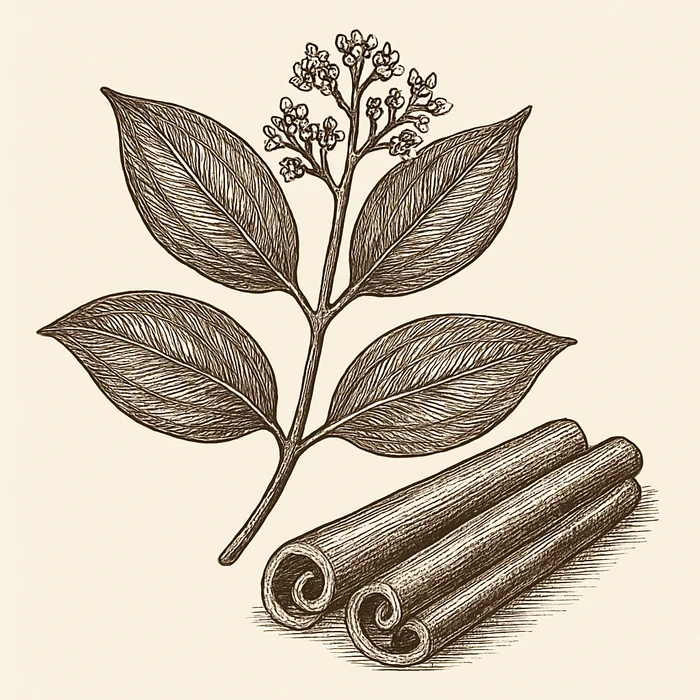
Cinnamon
Cinnamon may be the most pharmacologically active ingredient in your spice rack. Multiple meta-analyses of randomised controlled trials confirm it lowers fasting blood glucose, HbA1c, and cholesterol -- but there is a critical detail most people miss: there are two very different kinds, and one of them can damage your liver.
Why It Matters for Longevity
The book identifies cinnamon's potential to lower blood glucose and reverse fructose-induced insulin resistance, and the external evidence strongly supports this. Allen et al. (2013, Ann Fam Med) pooled 10 RCTs and found cinnamon supplementation (120 mg to 6g/day) reduced fasting blood glucose by an average of 24.6 mg/dL, with significant reductions in total cholesterol, LDL, and triglycerides. A systematic review and meta-analysis (Costello et al., 2016, J Acad Nutr Diet) confirmed the finding specifically in type 2 diabetes patients, reporting a clinically meaningful HbA1c reduction -- comparable to some first-line diabetes medications.
The mechanism involves multiple pathways. Chen et al. (2012, J Agric Food Chem) identified that cinnamon's Type A proanthocyanidins mimic insulin signalling, enhance glucose uptake into cells, improve glycogen synthesis, and inhibit gluconeogenesis in the liver. Type A proanthocyanidins are more bioavailable than the Type B form found in most other foods.
Now the critical distinction: most cinnamon sold worldwide is cassia (Cinnamomum cassia), which contains 0.3-1.2 g of coumarin per 100g. Coumarin is hepatotoxic at high doses, and the EU tolerable daily intake is just 0.1 mg/kg body weight. If you weigh 70 kg, that is 7 mg of coumarin -- roughly one teaspoon of cassia cinnamon. Ceylon cinnamon (Cinnamomum verum) contains 250 times less coumarin and is strongly preferred for regular daily consumption. If you are using cinnamon therapeutically, check which species you are buying.
Blood Pressure Effects
Cinnamon's cardiometabolic effects extend beyond glucose control. A meta-analysis of 9 RCTs (641 participants total) by Hadi et al. (2020, Clin Nutr ESPEN) found cinnamon supplementation reduced systolic blood pressure by 5.17 mmHg (95% CI: -9.35 to -0.99; p = 0.01) and diastolic blood pressure by 3.36 mmHg (95% CI: -5.67 to -1.04). Effect sizes were significant only when dosage was ≤2 g/day, duration exceeded 8 weeks, and participants had a baseline BMI ≥30 kg/m². A separate dose-response meta-analysis by Mousavi et al. (2020, Crit Rev Food Sci Nutr) pooled 9 trials and reported slightly larger reductions: -6.23 mmHg systolic (95% CI: -10.69 to -1.77) and -3.93 mmHg diastolic (95% CI: -6.33 to -1.52), with the greatest effects in participants under 50 and in trials lasting ≥12 weeks. For reference, a 5 mmHg reduction in systolic blood pressure is the approximate benefit of one additional antihypertensive medication in standard-to-high-risk populations.
The proposed mechanism involves cinnamaldehyde inhibiting angiotensin-converting enzyme (ACE) activity and reducing vascular smooth muscle calcium influx, but this pathway requires confirmation in human mechanistic studies. The blood pressure data are biologically plausible but should be considered hypothesis-generating rather than definitive given the heterogeneity across trials.
GLUT4 Translocation and the AMPK Pathway
The insulin-sensitising mechanism of cinnamon is more precisely understood than most food-drug interactions. Cinnamaldehyde, the compound responsible for cinnamon's characteristic aroma and flavour (comprising 65-80% of the essential oil), drives glucose uptake into skeletal muscle and adipose tissue by triggering GLUT4 transporter translocation to the cell membrane. The molecular cascade begins upstream: Anand et al. (2010, Chem Biol Interact) demonstrated in diabetic rats that cinnamaldehyde at 20 mg/kg body weight produced significant improvement (p < 0.001) in muscle and hepatic glycogen content, enhanced insulin secretion, and regulated both pyruvate kinase and phosphoenolpyruvate carboxykinase -- key glycolytic and gluconeogenic enzymes respectively.
The mechanism involves the LKB1-AMPK axis: Shen et al. (2014, PLoS One) showed that cinnamon extract phosphorylates AMPK and acetyl-CoA carboxylase in both 3T3-L1 adipocytes and C2C12 muscle cells, and that genetic knockdown of LKB1 (the upstream kinase that activates AMPK) completely abolished the glucose uptake enhancement -- proving LKB1-AMPK is not merely coincident but causally required. This is mechanistically distinct from insulin signalling, which operates via PI3K/Akt/AS160; cinnamon activates AMPK, the same energy-sensing pathway activated by exercise and metformin. This means cinnamon's glucose-lowering effects are additive to rather than redundant with insulin itself, which is clinically relevant for type 2 diabetic patients who have impaired insulin receptor signalling.
Type A proanthocyanidins add a parallel insulin-mimetic route: they directly activate the insulin receptor kinase, autophosphorylate the insulin receptor beta-subunit, and enhance PI3K/Akt signalling independent of cinnamaldehyde. The dual mechanism -- AMPK activation by cinnamaldehyde plus insulin receptor activation by procyanidins -- explains why whole cinnamon extract tends to outperform isolated cinnamaldehyde in head-to-head comparisons.
How to Use It
Use Ceylon cinnamon several times per week in cooking and teas. The book recommends adding it to poached fruit, lentil soups, and herbal teas. Buy sticks rather than pre-ground -- sticks retain flavour for up to three years, while ground cinnamon goes flat within months. Grind sticks fresh as needed. For blood glucose management, consume with or shortly before carbohydrate-containing meals. Therapeutic doses in studies ranged from 1-6g per day.
What to Pair It With
| Ingredient | Why | Tradition |
|---|---|---|
| Honey | Classic combination in teas and Middle Eastern dishes | Global |
| Turmeric | Combined in golden milk; complementary anti-inflammatory effects | Indian |
| Ginger | Warming spice pairing in chai and baking | Global |
| Legumes | Essential in Moroccan tagines and lentil soups | Middle Eastern / Moroccan |
| Oat porridge | Both independently lower blood glucose | Western |
| Dark chocolate | Traditional in Mexican hot chocolate | Mexican / European |
Flavor Profile
Cinnamon is warm, sweet, and woody with a gentle spiciness that is never aggressive. Ceylon cinnamon has a more delicate, slightly citrusy complexity; cassia is sharper and more one-dimensional. The aroma is distinctly sweet and comforting -- one of the most universally appealing smells in food. Sticks impart a subtler flavour over long cooking; ground cinnamon delivers immediate intensity.
The Science
- Allen et al., 2013, Ann Fam Med: Meta-analysis of 10 RCTs — cinnamon reduces fasting blood glucose by 24.6 mg/dL, plus LDL and triglycerides.
- Costello et al., 2016, J Acad Nutr Diet: Systematic review and meta-analysis — cinnamon supplementation reduces HbA1c in type 2 diabetes.
- Chen et al., 2012, J Agric Food Chem: Mechanistic study — Type A procyanidin oligomers from cinnamon mimic insulin and activate glucose transport via insulin receptor kinase and PI3K/Akt.
- Anand et al., 2010, Chem Biol Interact: Cinnamaldehyde at 20 mg/kg in diabetic rats produced significant (p < 0.001) improvement in muscle and hepatic glycogen via GLUT4 translocation; comparable efficacy to glibenclamide on insulin secretion.
- Shen et al., 2014, PLoS One: Cinnamon extract enhances glucose uptake in adipocytes and myocytes by phosphorylating AMPK via LKB1; LKB1 knockdown fully abolishes the effect, confirming LKB1-AMPK as the causal pathway.
- Hadi et al., 2020, Clin Nutr ESPEN: Meta-analysis of 9 RCTs (n = 641) — cinnamon reduces systolic BP by 5.17 mmHg and diastolic BP by 3.36 mmHg; effect significant at ≤2 g/day for >8 weeks in BMI ≥30 participants.
- Mousavi et al., 2020, Crit Rev Food Sci Nutr: Dose-response meta-analysis — systolic BP reduction 6.23 mmHg, diastolic 3.93 mmHg; largest effects in under-50s and ≥12-week trials.
References
- Allen RW, Schwartzman E, Baker WL, Coleman CI, Phung OJ. Cinnamon use in type 2 diabetes: an updated systematic review and meta-analysis. Ann Fam Med. 2013;11(5):452-459. PMID: 24019277. doi:10.1370/afm.1517
- Costello RB, Dwyer JT, Saldanha L, Bailey RL, Merkel J, Wambogo E. Do Cinnamon Supplements Have a Role in Glycemic Control in Type 2 Diabetes? A Narrative Review. J Acad Nutr Diet. 2016;116(11):1794-1802. PMID: 27618575. doi:10.1016/j.jand.2016.07.015
- Chen L, Sun P, Wang T, et al. Diverse mechanisms of antidiabetic effects of the different procyanidin oligomer types of two different cinnamon species on db/db mice. J Agric Food Chem. 2012;60(36):9144-9150. PMID: 22920511. doi:10.1021/jf3024535
- Anand P, Murali KY, Tandon V, Murthy PS, Chandra R. Insulinotropic effect of cinnamaldehyde on transcriptional regulation of pyruvate kinase, phosphoenolpyruvate carboxykinase, and GLUT4 translocation in experimental diabetic rats. Chem Biol Interact. 2010;186(1):72-81. PMID: 20363216.
- Shen Y, Honma N, Kobayashi K, et al. Cinnamon extract enhances glucose uptake in 3T3-L1 adipocytes and C2C12 myocytes by inducing LKB1-AMP-activated protein kinase signaling. PLoS One. 2014;9(2):e87894. PMID: 24551069.
- Hadi A, Campbell MS, Hassani B, Pourmasoumi M, Salehi-Sahlabadi A, Hosseini SA. The effect of cinnamon supplementation on blood pressure in adults: A systematic review and meta-analysis of randomized controlled trials. Clin Nutr ESPEN. 2020;36:10-16. PMID: 32220351.
- Mousavi SM, Karimi E, Hajishafiee M, Milajerdi A, Amini MR, Esmaillzadeh A. Anti-hypertensive effects of cinnamon supplementation in adults: A systematic review and dose-response Meta-analysis of randomized controlled trials. Crit Rev Food Sci Nutr. 2020;60(18):3144-3154. PMID: 31617744.
Key Nutrients
| Nutrient | Per 100g | Notes |
|---|---|---|
| Cinnamaldehyde | 1-4 g | Primary active compound; anti-diabetic and antimicrobial |
| Proanthocyanidins (Type A) | 8-12 g | Insulin-mimetic; more bioavailable than Type B |
| Coumarin | 0.3-1.2 g (cassia); trace (Ceylon) | Hepatotoxic at high doses; prefer Ceylon for daily use |
| Manganese | 17.5 mg (760% RDA) | Very rich source; small serving sizes |