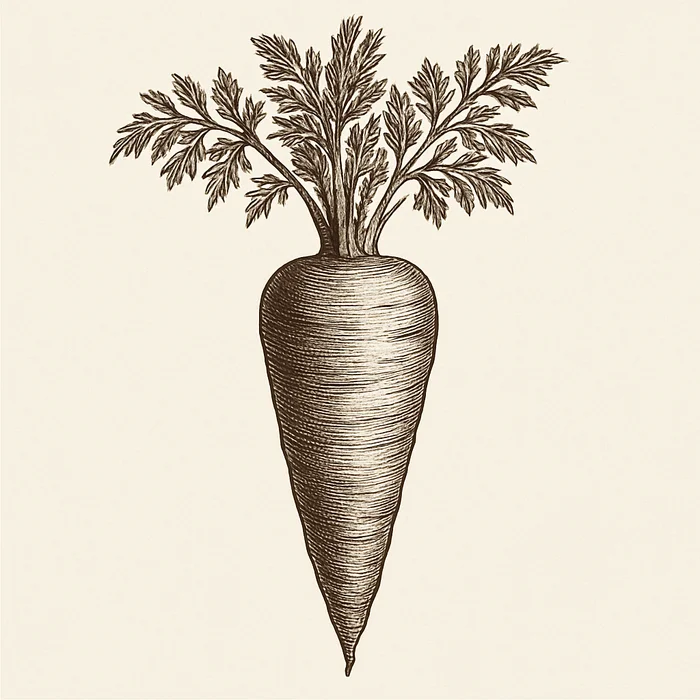
Carrots
Steaming and pureeing carrots triples the amount of beta-carotene your body actually absorbs compared to eating them raw. Add a drizzle of olive oil and you push absorption even higher -- because carotenoids are fat-soluble and need a lipid escort to cross the intestinal wall.
Why It Matters for Longevity
Carrots are the most accessible source of beta-carotene in most diets, and beta-carotene converts to vitamin A, which is fundamental to immune function, eye health, and cellular differentiation. But carrots contain more than just beta-carotene. They also carry alpha-carotene -- a compound inversely associated with all-cause mortality -- and falcarinol, a polyacetylene with anti-inflammatory and anti-carcinogenic properties.
An umbrella review of 49 meta-analyses found that carrot intake and higher circulating carotenoid levels are consistently associated with reduced risk of cardiovascular disease, cancer, and all-cause mortality, with dose-response relationships evident across multiple health outcomes (Yi et al., 2023, J Sci Food Agric).
Alpha-Carotene and Mortality Risk
Alpha-carotene -- found in highest concentrations in carrots, where it accounts for roughly 30% of total carotenoid content -- has attracted specific attention in longevity research because its epidemiological signal is at least as strong as that of its better-known sibling, beta-carotene.
A prospective follow-up of 15,318 US adults (NHANES III) tracked through the National Death Index found a clear dose-response relationship between serum alpha-carotene and all-cause mortality. Compared to individuals with serum alpha-carotene below 1 µg/dL, those with concentrations of 2--3 µg/dL had a 23% lower risk of death (HR 0.77, 95% CI 0.68--0.87), and those above 9 µg/dL had a 39% lower risk (HR 0.61, 95% CI 0.51--0.73). Associations held for cardiovascular disease, cancer, and other cause-specific mortality alike (Li et al., 2011, Arch Intern Med).
A second large analysis of 8,390 hypertensive adults (NHANES III and 2001--2006, median follow-up 16.6 years) confirmed the finding. Highest versus lowest quartile of serum alpha-carotene was associated with a 37% lower all-cause mortality (HR 0.63, 95% CI 0.56--0.71) and a 32% lower cardiovascular mortality (HR 0.68, 95% CI 0.55--0.86) -- a stronger signal than any other carotenoid measured in the same dataset (Zhu et al., 2023, J Am Heart Assoc). The nonlinear inflection point for cardiovascular benefit was at 2.31 µg/dL, a concentration achievable through regular carrot consumption without supplementation.
These associations are observational and confounding by overall diet quality cannot be fully excluded. Nonetheless, the consistency across independent cohorts with different follow-up periods and analytic approaches gives the alpha-carotene signal unusual credibility.
Falcarinol and Colorectal Cancer
Carrots contain polyacetylenic oxylipins -- falcarinol and its congener falcarindiol -- that are found in meaningful quantities only in the Apiaceae family. These are not antioxidants in the conventional sense; they work through direct modulation of inflammatory signaling and interference with cell proliferation pathways in the colonic epithelium.
Dietary falcarinol and falcarindiol from carrots prevented intestinal inflammation and colon carcinogenesis in rodent models, supporting the epidemiological signal for carrot intake in colorectal cancer prevention (Kobaek-Larsen et al., 2019, Nutrients). Falcarinol is concentrated in the peel and in the outer cortex of the root; peeling removes a substantial fraction of this compound.
A large prospective cohort study of 101,680 participants from the PLCO Cancer Screening Trial found that the 4th quintile of dietary carrot intake was associated with a 21% lower risk of colorectal cancer incidence (HR 0.79, 95% CI 0.65--0.97) compared to the lowest quintile -- while alpha- and beta-carotene measured in isolation showed no statistically significant association with colorectal cancer (Jiang et al., 2022, Front Nutr). The authors interpreted this as evidence that whole carrot consumption may confer protection through the falcarinol-class compounds rather than carotene alone.
Beta-Carotene Bioavailability
Beta-carotene bioavailability from carrots is dramatically enhanced by cooking and mechanical disruption of the plant matrix. The cell wall must be broken to release carotenoids from chromoplasts, and a lipid vehicle is needed for micellarization and intestinal uptake.
Pureed cooked carrots provided significantly more bioavailable beta-carotene than raw whole carrots in human ileostomy volunteers; the processing effect was large enough to matter clinically for individuals dependent on carrots as their primary vitamin A source (Livny et al., 2003, Eur J Nutr). Steam-cooking without excessive water contact preserves the carotenoid matrix while softening cell walls; boiling in water leaches water-soluble micronutrients but does not reduce carotenoids substantially.
How to Use It
For maximum beta-carotene: steam until tender and puree, then eat with a fat source (olive oil, tahini, avocado). Raw carrots are still worthwhile -- you absorb less beta-carotene but retain more falcarinol and vitamin C. Roasted carrots develop deep caramel sweetness and retain most carotenoids.
Leave the skin on (or scrub rather than peel) to preserve the falcarinol-dense outer layer. If buying conventionally grown carrots, the peel still retains more polyacetylenes than the core, even if pesticide residues are a consideration.
What to Pair It With
| Ingredient | Why | Tradition |
|---|---|---|
| Extra-virgin olive oil | Fat required for carotenoid absorption | Mediterranean |
| Ginger | Anti-inflammatory synergy; carrot-ginger soup | East Asian / Modern |
| Cumin | Warm spice complements sweetness in Moroccan salads | North African |
| Lemon | Acid balances sweetness; vitamin C enhances iron absorption | Mediterranean |
| Tahini | Fat aids carotenoid absorption; flavour in roasted carrot dishes | Middle Eastern |
| Celery | Same Apiaceae family; mirepoix foundation | French |
Flavor Profile
Raw carrots are crunchy, mildly sweet, and slightly bitter at the core. Roasting concentrates their sugar into deep caramel notes with earthy undertones. Pureed, they become silky and warm. The aroma shifts from earthy-woody (raw) to sweet and almost honey-like (cooked).
The Science
- Yi et al., 2023, J Sci Food Agric: Umbrella review of 49 meta-analyses -- carrot intake and circulating carotenoids consistently associated with reduced cardiovascular disease, cancer, and all-cause mortality.
- Li et al., 2011, Arch Intern Med: NHANES III prospective cohort (n=15,318); serum alpha-carotene dose-dependently associated with lower all-cause mortality; HR 0.61 at highest concentration vs. lowest.
- Zhu et al., 2023, J Am Heart Assoc: NHANES cohort of 8,390 hypertensive adults, 16.6-year follow-up; alpha-carotene showed strongest all-cause mortality signal (HR 0.63) and 32% lower cardiovascular mortality.
- Kobaek-Larsen et al., 2019, Nutrients: Dietary falcarinol and falcarindiol from carrots prevented intestinal inflammation and colon carcinogenesis in rodent models.
- Jiang et al., 2022, Front Nutr: PLCO trial cohort (n=101,680); 4th quintile carrot intake associated with 21% lower colorectal cancer incidence (HR 0.79); isolated carotenoids not significant, implicating falcarinol.
- Livny et al., 2003, Eur J Nutr: Pureed cooked carrots provided significantly more bioavailable beta-carotene than raw whole carrots in human ileostomy volunteers.
References
- Yi X, Liu Z, Chen S, et al. Carrot and carotene and multiple health outcomes: an umbrella review of the evidence. J Sci Food Agric. 2023;103(7):3339-3347. PMID: 36600678. doi:10.1002/jsfa.12398
- Li C, Ford ES, Zhao G, Balluz LS, Giles WH, Liu S. Serum α-carotene concentrations and risk of death among US Adults: the Third National Health and Nutrition Examination Survey Follow-up Study. Arch Intern Med. 2011;171(6):507-515. PMID: 21098341. doi:10.1001/archinternmed.2010.440
- Zhu X, Cheang I, Tang Y, et al. Associations of Serum Carotenoids With Risk of All-Cause and Cardiovascular Mortality in Hypertensive Adults. J Am Heart Assoc. 2023;12(4):e027947. PMID: 36752230. doi:10.1161/JAHA.122.027947
- Kobaek-Larsen M, El-Houri RB, Christensen LP, et al. Dietary polyacetylenic oxylipins falcarinol and falcarindiol prevent inflammation and colorectal neoplastic transformation: a mechanistic and dose-finding study in rats. Nutrients. 2019;11(9):2223. PMID: 31540047. doi:10.3390/nu11092223
- Jiang Z, Chen H, Li M, Wang W, Fan C, Long F. Association of Dietary Carrot/Carotene Intakes With Colorectal Cancer Incidence and Mortality in the Prostate, Lung, Colorectal, and Ovarian Cancer Screening Trial. Front Nutr. 2022;9:897984. PMID: 35782935. doi:10.3389/fnut.2022.897984
- Livny O, Reifen R, Levy I, et al. Beta-carotene bioavailability from differently processed carrot meals in human ileostomy volunteers. Eur J Nutr. 2003;42(6):338-345. PMID: 14673607. doi:10.1007/s00394-003-0430-x
Key Nutrients
| Nutrient | Per 100g | Notes |
|---|---|---|
| Beta-carotene | 8285 mcg (raw); higher bioavailability when cooked | 3x more bioavailable pureed/cooked; fat required for absorption |
| Alpha-carotene | 3477 mcg | Dose-dependently associated with lower all-cause and CVD mortality in NHANES cohorts; inflection point for cardiovascular benefit ~2.3 µg/dL serum |
| Falcarinol | 1-7 mg | Concentrated in peel; anti-inflammatory polyacetylene; protective against colorectal cancer in animal models; implicated in whole-carrot CRC cohort data |
| Fiber | 2.8 g (mostly soluble pectin) | Prebiotic; explains low glycemic load despite moderate GI |