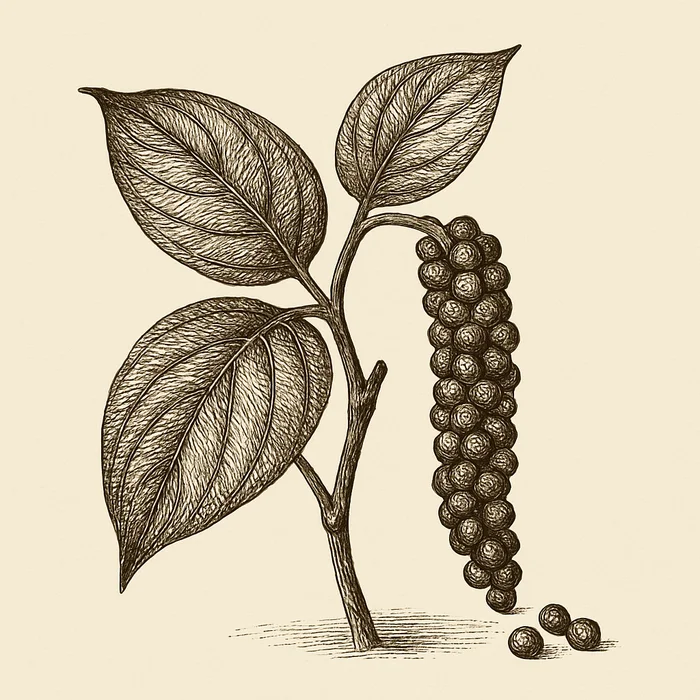
Black Pepper
Black pepper's longevity value is not about what it does alone -- it is about what it makes possible. Piperine, the compound responsible for pepper's bite, increases curcumin absorption by 2000%. That is not a typo. Without black pepper, most of the turmeric you eat passes through your body unused.
Why It Matters for Longevity
The landmark study is Shoba et al. (1998, Planta Medica), which demonstrated that 20 mg of piperine -- roughly a quarter teaspoon of black pepper -- increased curcumin bioavailability by twenty-fold in human subjects. The mechanism is well understood: piperine inhibits hepatic and intestinal glucuronidation, the enzyme process that normally tags curcumin for rapid elimination. Block that process, and curcumin stays in the bloodstream long enough to exert its anti-inflammatory effects.
But piperine is not a one-trick molecule. A comprehensive review (Butt et al., 2013, Crit Rev Food Sci Nutr) documented piperine's role as a general bioenhancer by inhibiting CYP3A4 and CYP1A2 enzymes plus P-glycoprotein efflux pumps -- enhancing absorption of resveratrol, EGCG, selenium, vitamin B6, and beta-carotene. Every time you grind pepper onto a meal containing these compounds, you are amplifying their bioavailability.
Piperine also has independent anti-inflammatory and antioxidant properties, including anticancer activity in cell culture and anti-inflammatory effects through COX and LOX pathway inhibition. Black pepper also contains beta-caryophyllene, a dietary cannabinoid that activates CB2 receptors -- providing anti-inflammatory effects without any psychoactive component.
One important caveat: the same enzyme inhibition that enhances nutrient absorption also affects pharmaceutical drugs. If you take medications metabolised by CYP3A4 (a long list including statins, blood thinners, and some antidepressants), be aware that heavy pepper consumption could alter drug levels. This is worth discussing with a pharmacist.
The Anti-Inflammatory Mechanism in Detail
Piperine's anti-inflammatory activity runs through the NF-κB and MAPK signaling cascades. NF-κB is the transcription factor that drives expression of inflammatory cytokines (IL-1β, IL-6, TNF-α) and enzymes (COX-2, iNOS). In experimental systems, piperine suppresses NF-κB nuclear translocation and downstream gene expression; it simultaneously inhibits phosphorylation of ERK, JNK, and p38 — the three main MAPK kinases that feed into inflammatory amplification.
Bang et al. (2009, Arthritis Research & Therapy, PMID 19327174) tested piperine directly in human tissue: synoviocytes isolated from rheumatoid arthritis patients showed dose-dependent reductions in IL-6, MMP-13, and prostaglandin E2 (PGE2) production, with significant suppression at 10 μg/mL for PGE2. The molecular mechanism in that study operated through AP-1 inhibition rather than NF-κB nuclear translocation, which is consistent with piperine having multiple parallel targets rather than a single dominant pathway. In a rat arthritis model in the same paper, oral piperine produced measurable reduction in pain responses by day 8 and in arthritic symptoms by day 4, with histologically confirmed reduction in inflammatory infiltration of ankle tissue. These are animal endpoints, but the complementary human cell data strengthens the case for the mechanism.
A 2022 review in Beni-Suef University Journal of Basic and Applied Sciences (Tripathi et al., PMID 35127957) surveyed 11 completed clinical trials and 5 ongoing investigations across conditions including knee osteoarthritis, metabolic syndrome, non-alcoholic fatty liver disease, and vitiligo. One trial found that 15 mg/day piperine for six weeks produced significant anti-inflammatory effects in osteoarthritis patients. Piperine's half-life in human pharmacokinetic studies is 13.2–15.8 hours — meaning once-daily culinary use maintains a low-level steady-state presence in the bloodstream.
Enzyme Inhibition and Bioavailability: The Numbers
The CYP3A4/P-glycoprotein inhibition that makes piperine a bioenhancer is dose-dependent and documented across multiple compounds:
- Curcumin: 20 mg piperine co-administered with curcumin → 20-fold increase in serum curcumin AUC in humans (Shoba et al., 1998)
- Beta-carotene: ~60% increase in serum response with piperine co-administration (Tripathi et al., 2022, from clinical data)
- Silybin (milk thistle active): 146–181% bioavailability increase
- EGCG (green tea): enhanced absorption via CYP1A2 and P-gp inhibition
The mechanism is not stimulation of absorption transporters but suppression of elimination pathways — piperine buys time for compounds to circulate before they are metabolized or effluxed back into the gut lumen. This is why the co-administration timing matters: piperine should be consumed with the compound whose bioavailability you want to increase, not hours apart.
Thermogenesis: Promising Mechanism, Unconfirmed in Humans
Piperine has been shown to upregulate uncoupling protein 1 (UCP1) expression in muscle cells via an AMPK-dependent pathway and to destabilize the super-relaxed (SRX) myosin state, increasing resting muscle thermogenesis in vitro. In rodent studies, these effects are sufficient to reduce obesity and improve metabolic parameters. However, the affinity of piperine for its molecular targets is estimated to be too low for effective thermogenesis at the doses achievable in humans without unfavorable side effects. This is an area where the mechanistic story is compelling but human clinical evidence is not yet available. Culinary use of black pepper should not be expected to produce meaningful thermogenic effects on its own.
How to Use It
Always grind fresh. Pre-ground pepper loses volatile oils and piperine content within weeks. The book recommends small amounts daily alongside turmeric-containing dishes. A few grinds of pepper on any meal containing turmeric, green tea polyphenols, or resveratrol-rich foods will meaningfully increase absorption. There is no benefit to consuming large amounts -- piperine's bioenhancing effect plateaus at moderate doses.
What to Pair It With
| Ingredient | Why | Tradition |
|---|---|---|
| Turmeric | Piperine increases curcumin bioavailability 2000% | Indian / Global |
| Extra-virgin olive oil | Fat carrier for piperine; cacio e pepe | Mediterranean |
| Lemon | Acid-heat contrast in dressings | Global |
| Garlic | Universal aromatic pairing | Global |
| Ginger | Complementary warming spices | Indian / East Asian |
| Green tea | Piperine enhances EGCG absorption | Functional pairing |
Flavor Profile
Black pepper is sharp, warm, and pungent with subtle piney and citrusy notes. Freshly cracked peppercorns have a complexity that pre-ground pepper entirely lacks -- floral and almost fruity at first, with a lingering warmth. Coarsely ground pepper provides textural crunch; finely ground dissolves into dishes for even heat distribution.
The Science
- Shoba et al., 1998, Planta Medica: Piperine (20 mg) increases curcumin bioavailability by ~20-fold in humans via inhibition of hepatic and intestinal glucuronidation.
- Butt et al., 2013, Crit Rev Food Sci Nutr: Comprehensive review — black pepper and piperine as bioenhancer (CYP3A4/CYP1A2/P-gp inhibition), anti-inflammatory, and anticancer agent.
- Bang et al., 2009, Arthritis Res Ther: Piperine dose-dependently inhibited IL-6, MMP-13, and PGE2 in human rheumatoid synoviocytes; reduced pain and arthritic symptoms in rat models beginning day 4–8.
- Tripathi et al., 2022, Beni-Suef Univ J Basic Appl Sci: Review of 11 completed piperine clinical trials — 15 mg/day for 6 weeks showed significant anti-inflammatory effects in osteoarthritis; half-life 13.2–15.8 hours; bioavailability enhancement documented for multiple compounds.
References
- Shoba G, Joy D, Joseph T, Majeed M, Rajendran R, Srinivas PS. Influence of piperine on the pharmacokinetics of curcumin in animals and human volunteers. Planta Med. 1998;64(4):353-356. PMID: 9619120. doi:10.1055/s-2006-957450
- Butt MS, Pasha I, Sultan MT, Randhawa MA, Saeed F, Ahmed W. Black pepper and health claims: a comprehensive treatise. Crit Rev Food Sci Nutr. 2013;53(9):875-886. PMID: 23768180. doi:10.1080/10408398.2011.571799
- Bang JS, Oh DH, Choi HM, et al. Anti-inflammatory and antiarthritic effects of piperine in human interleukin 1beta-stimulated fibroblast-like synoviocytes and in rat arthritis models. Arthritis Res Ther. 2009;11(2):R49. PMID: 19327174. doi:10.1186/ar2662
- Tripathi AK, Ray AK, Mishra SK. Molecular and pharmacological aspects of piperine as a potential molecule for disease prevention and management: evidence from clinical trials. Beni-Suef Univ J Basic Appl Sci. 2022;11(1):16. PMID: 35127957. doi:10.1186/s43088-022-00196-1
Key Nutrients
| Nutrient | Per 100g | Notes |
|---|---|---|
| Piperine | 5-9 g | Bioenhancer; inhibits drug metabolism enzymes. Caution with medications |
| Beta-caryophyllene | Major terpene | Dietary CB2 agonist; anti-inflammatory without psychoactive effects |
| Manganese | 12.8 mg (556% RDA) | One of the richest food sources; small serving sizes |