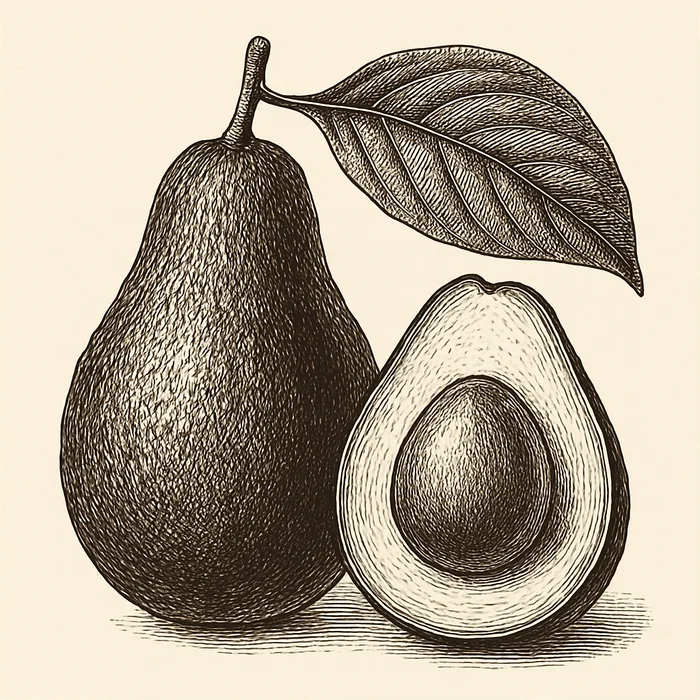
Avocado
A fatty fruit that behaves like an oil in your body -- and a Harvard study of 110,000 people found eating two servings a week cut cardiovascular disease risk by 16% and coronary heart disease by 21%.
Why It Matters for Longevity
Avocado is essentially an olive oil delivery vehicle disguised as a fruit. About 70% of its calories come from monounsaturated oleic acid, the same fatty acid that dominates extra-virgin olive oil. Fontana groups avocado alongside olive oil and nuts as plant-origin MUFA sources, noting that plant-origin monounsaturated fat is specifically associated with lower cardiovascular and cancer mortality -- a distinction that matters, because the same fatty acid from animal sources does not carry the same benefit (Ref 69).
The cardiovascular evidence is substantial. A prospective cohort study (Pacheco et al., 2022, JAHA) tracked over 110,000 U.S. adults for up to 30 years and found those eating 2+ servings of avocado per week had 16% lower cardiovascular disease risk and 21% lower coronary heart disease risk. A clinical trial in adults with overweight (Olavarría et al., 2021, Medicine) found that an avocado-based Mediterranean diet improved serum lipids including LDL in secondary prevention.
Beyond its own nutrient profile, avocado functions as an absorption multiplier. Its fat content dramatically increases uptake of fat-soluble carotenoids from other foods. Add avocado to a salad and you absorb 3-5x more beta-carotene and lutein from the greens. Pair it with tomato and lycopene absorption jumps 2-4x. This synergy effect makes avocado a strategic ingredient, not just a nutritious one.
The fruit also delivers 6.7g of fibre per 100g -- among the highest of any fruit -- along with more potassium per serving than a banana (485mg per 100g). It is one of the richest food sources of glutathione. NHANES analysis (Fulgoni et al., 2013, Nutr J) showed avocado consumers had significantly higher intakes of key nutrients, lower BMI, and reduced metabolic syndrome prevalence.
Carotenoid Absorption: The Multiplier Effect Quantified
The most striking nutritional role of avocado is as a fat vehicle for carotenoid absorption from other foods eaten at the same meal. The mechanism is straightforward: carotenoids are fat-soluble pigments that require micellar solubilization in the small intestine to be absorbed. Without dietary fat, most of the beta-carotene and lutein in a raw salad passes through unabsorbed.
A crossover study (Unlu et al., 2005, J Nutr) quantified this effect precisely. In 11 healthy participants, adding 150g of avocado to salsa increased lycopene absorption 4.4-fold and beta-carotene absorption 2.6-fold compared to avocado-free salsa. Adding avocado to a raw salad boosted alpha-carotene absorption 7.2-fold, beta-carotene 15.3-fold, and lutein 5.1-fold versus unsupplemented salad. Notably, avocado oil produced the same enhancement as whole avocado fruit, confirming that the lipid fraction is the active driver. These are not marginal improvements -- a 15-fold increase in beta-carotene absorption represents the difference between a salad functioning as a meaningful carotenoid source and one that contributes almost none.
This effect has direct implications for how avocado should be used. Adding even a quarter or half avocado to any mixed salad containing dark greens, tomatoes, or orange-colored vegetables meaningfully transforms the nutritional value of the entire meal, not just the avocado portion.
LDL Quality, Not Just Quantity
Avocado's effect on LDL is more nuanced than simple total-cholesterol reduction. A randomized controlled trial (Wang et al., 2015, JAHA) tested three cholesterol-lowering diets in 45 overweight and obese adults over 5 weeks: a lower-fat diet, a moderate-fat diet, and a moderate-fat diet with one fresh Hass avocado (136g) per day. The avocado diet reduced LDL cholesterol by 13.5 mg/dL -- more than the lower-fat (7.4 mg/dL) and moderate-fat (8.3 mg/dL) controls. But the more important finding was the effect on LDL particle architecture: the avocado diet uniquely reduced LDL particle number by 80.1 nmol/L, small dense LDL cholesterol by 4.1 mg/dL, and the LDL-to-HDL ratio by 6.6%. Small dense LDL particles are more atherogenic than large buoyant ones because they are more easily oxidized and penetrate the arterial wall more readily. Shifting the LDL pool toward larger, less dense particles -- even at comparable total LDL levels -- represents a meaningful reduction in cardiovascular risk.
A follow-up study (Wang et al., 2020, J Nutr) from the same group confirmed that one avocado per day in a moderate-fat diet reduced oxidized LDL (oxLDL) by 7.0 U/L (-8.8%) compared to control diets. Plasma lutein concentration increased by 19.6 nmol/L (68.7%) in the avocado group, and this change in lutein tracked closely with the reduction in oxLDL -- suggesting that avocado's carotenoid content contributes directly to LDL oxidation protection, not just the oleic acid.
Beta-Sitosterol and Cholesterol Competition
Avocado contains approximately 76-123mg of beta-sitosterol per 100g, making it one of the more concentrated whole-food sources of plant sterols. Beta-sitosterol is structurally similar enough to cholesterol that it competes for the same intestinal absorption sites. By occupying Niemann-Pick C1-Like 1 (NPC1L1) transporters in the brush border of the small intestine, plant sterols reduce the re-absorption of both dietary and biliary cholesterol, ultimately lowering circulating LDL. The concentration in avocado, while lower than concentrated phytosterol supplements, is nutritionally relevant and contributes to the LDL-lowering observed in clinical trials across a range of doses and food matrices.
How to Use It
Half an avocado (about 70g) daily or a whole one several times a week aligns with the research doses. Eat it raw to preserve the MUFA and glutathione content -- heat does not destroy oleic acid, but it degrades more delicate antioxidants. Slice onto salads, mash into guacamole with lime and tomato, spread on whole-grain toast, or blend into smoothies for creaminess. The fat content makes it an ideal vehicle for absorbing nutrients from accompanying vegetables.
What to Pair It With
| Ingredient | Why | Tradition |
|---|---|---|
| Tomato | Avocado fat boosts lycopene absorption 2-4x | Mexican (guacamole) |
| Leafy greens | Fat increases carotenoid absorption 5-15x from greens | Mediterranean / Global |
| Lime / lemon juice | Vitamin C prevents browning; acidity balances richness | Latin American |
| Extra-virgin olive oil | Complementary MUFA profiles; combined cardiovascular benefit | Mediterranean |
| Black beans | Complete protein pairing; traditional and evidence-based | Mexican / Central American |
Flavor Profile
Buttery and silky with a subtle nuttiness and faint grassy undertone. The aroma is green and fresh, almost herbaceous. Texture is dense, creamy, and smooth -- it coats the palate like a soft cheese. Ripe avocado has a richness that bridges savoury and neutral, making it a flavour canvas that amplifies whatever you pair it with. Unripe fruit is firm, waxy, and slightly bitter.
The Science
- Pacheco et al., 2022, J Am Heart Assoc: 110,000+ adults, 30-year follow-up — 2+ servings/week linked to 16% lower CVD risk and 21% lower CHD risk.
- Olavarría et al., 2021, Medicine: Avocado-based Mediterranean diet improved serum lipids in secondary prevention.
- Fulgoni et al., 2013, Nutr J: NHANES analysis — avocado consumers had higher nutrient intakes, lower BMI, reduced metabolic syndrome.
- Unlu et al., 2005, J Nutr: Crossover RCT (11 participants) — adding avocado to salad increased beta-carotene absorption 15.3x, lutein 5.1x, lycopene from salsa 4.4x.
- Wang et al., 2015, JAHA: RCT (45 adults, 5 weeks) — one avocado/day reduced LDL-C 13.5 mg/dL, LDL particle number 80.1 nmol/L, small dense LDL 4.1 mg/dL.
- Wang et al., 2020, J Nutr: RCT (45 adults) — one avocado/day reduced oxidized LDL 7.0 U/L (-8.8%); plasma lutein rose 68.7%, correlating with oxLDL reduction.
References
- Pacheco LS, Li Y, Rimm EB, et al. Avocado Consumption and Risk of Cardiovascular Disease in US Adults. J Am Heart Assoc. 2022;11(7):e024014. PMID: 35352568. doi:10.1161/JAHA.121.024014
- Olavarría VV, González-Arazo MM, Olivares A, et al. Effects of an Avocado-based Mediterranean Diet on Serum Lipids for Secondary Prevention after Stroke. Medicine (Baltimore). 2021;100(29):e26425. PMID: 34128908. doi:10.1097/MD.0000000000026425
- Fulgoni VL 3rd, Dreher M, Davenport AJ. Avocado consumption is associated with better diet quality and nutrient intake, and lower metabolic syndrome risk in US adults: results from the National Health and Nutrition Examination Survey (NHANES) 2001-2008. Nutr J. 2013;12:1. PMID: 23282226. doi:10.1186/1475-2891-12-1
- Unlu NZ, Bohn T, Clinton SK, Schwartz SJ. Carotenoid absorption from salad and salsa by humans is enhanced by the addition of avocado or avocado oil. J Nutr. 2005;135(3):431-436. PMID: 15735074. doi:10.1093/jn/135.3.431
- Wang L, Bordi PL, Fleming JA, Hill AM, Kris-Etherton PM. Effect of a moderate fat diet with and without avocados on lipoprotein particle number, size and subclasses in overweight and obese adults: a randomized, controlled trial. J Am Heart Assoc. 2015;4(1):e001355. PMID: 25567051. doi:10.1161/JAHA.114.001355
- Wang L, Tao L, Hao L, et al. A Moderate-Fat Diet with One Avocado per Day Increases Plasma Antioxidants and Decreases the Oxidation of Small, Dense LDL in Adults with Overweight and Obesity: A Randomized Controlled Trial. J Nutr. 2020;150(2):276-284. PMID: 31616932. doi:10.1093/jn/nxz231
Key Nutrients
| Nutrient | Per 100g | Notes |
|---|---|---|
| Oleic acid (MUFA) | ~9.8 g | Same fatty acid as olive oil; reduces LDL without lowering HDL |
| Potassium | 485 mg (10% DV) | More than banana; supports blood pressure regulation |
| Dietary fibre | 6.7 g | Among highest of any fruit; mix of soluble and insoluble |
| Lutein + zeaxanthin | ~271 mcg | Highly bioavailable due to own fat content; protects against macular degeneration |
| Glutathione | ~17.7 mg | One of richest food sources of the body's master antioxidant |
| Beta-sitosterol | 76-123 mg | Competes with cholesterol at NPC1L1 intestinal transporter; lowers LDL |