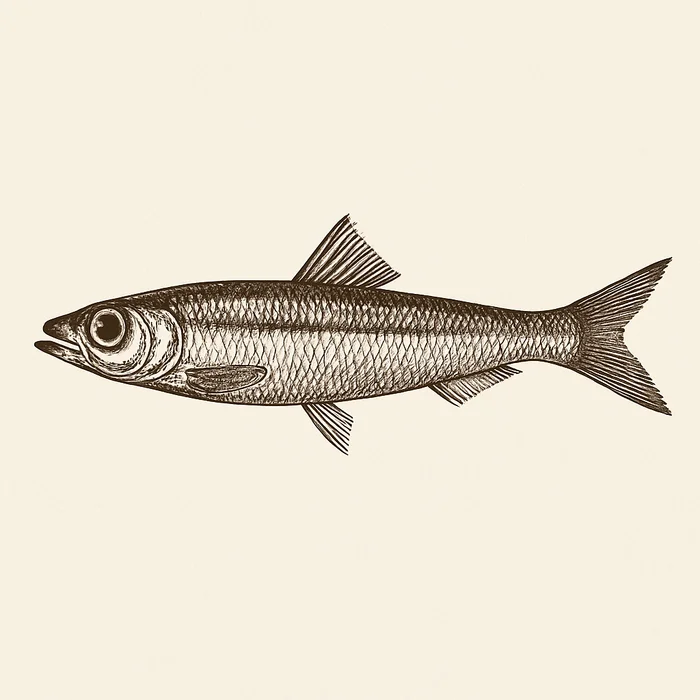
Anchovies
Small, oily, and wildly underrated. Anchovies pack more omega-3 per gram than most fish — with the lowest mercury burden of any seafood and a nutrient density that rivals foods eaten in multiples.
Why It Matters for Longevity
EPA/DHA: Anti-Inflammatory Mechanisms That Matter
Anchovies deliver 1.5–2.1 g of EPA + DHA per 100 g of drained fillets, placing them in the top tier of dietary omega-3 sources. These two long-chain polyunsaturated fatty acids are not interchangeable with plant-derived ALA: EPA and DHA are the active forms that the body uses directly to suppress chronic inflammation, stabilize cardiac rhythm, and protect vascular endothelium.
At the cellular level, EPA and DHA work through at least three interlocking pathways. First, they displace arachidonic acid (AA) from membrane phospholipids, which reduces the substrate available for pro-inflammatory eicosanoid synthesis (prostaglandin E₂, leukotriene B₄). Second, they serve as precursors to resolvins and protectins — specialized pro-resolving mediators that actively terminate inflammation rather than simply damping it. Third, they down-regulate nuclear factor kappa B (NF-κB), the master transcription factor that drives expression of TNF-α, IL-1β, IL-6, and other cytokines linked to cardiovascular disease, cognitive decline, and accelerated biological aging.
The cardiovascular evidence is substantial. A 2021 meta-analysis of 25 prospective cohort studies encompassing 2,027,512 participants and 103,734 cardiovascular deaths found that fish consumption was inversely associated with CVD mortality risk (RR = 0.91; 95% CI 0.85–0.98), and that higher marine n-3 PUFA intake was associated with even greater risk reduction (RR = 0.87; 95% CI 0.85–0.89). The dose-response curve showed a 4% decrease in CVD mortality for every additional 20 g of fish per day — roughly two anchovy fillets Jiang et al., 2021, Nutrients. A separate meta-analysis of 38 randomized controlled trials in 149,051 participants confirmed that omega-3 supplementation reduced cardiovascular mortality by 7% (RR 0.93), non-fatal MI by 13% (RR 0.87), and coronary heart disease events by 9% (RR 0.91) Khan et al., 2021, EClinicalMedicine. The earlier landmark meta-analysis by Rizos et al. (2012, JAMA) similarly documented significant reductions in cardiac death and non-fatal MI PMID 22968891.
One nuance: high-dose EPA supplementation (≥2–4 g/day pharmacological doses) carries a modestly elevated atrial fibrillation risk. Dietary intake from whole fish — the 1–2 g EPA+DHA range that anchovies represent in a normal serving — has not been associated with this signal, and the cohort data above reflects food intake, not supplements.
The Low-Mercury Argument: Why Size and Lifespan Matter
Mercury contamination of fish is a legitimate concern, but it is not evenly distributed across species. It accumulates by biomagnification: large, long-lived predators at the top of the food chain — swordfish, shark, king mackerel, bigeye tuna — spend years absorbing and retaining methylmercury from the smaller organisms they consume. Anchovies short-circuit this process entirely.
The European anchovy (Engraulis encrasicolus) lives 3–4 years at most, reaches 12–20 cm, and feeds almost exclusively on zooplankton and small crustaceans — two trophic levels below the large predators. The result is a methylmercury content consistently below 0.01 ppm in monitoring data, compared to 0.97 ppm in swordfish or 0.35 ppm in canned albacore tuna. The U.S. FDA and EPA explicitly list anchovies among the "best choices" for pregnant women and young children — populations for whom mercury exposure carries the greatest risk. For everyone else, the anchovy's minuscule mercury load means the omega-3 benefit is entirely uncompromised by heavy-metal cost.
Sardines, sprats, and mackerel occupy a similar position for the same structural reasons. The pattern is consistent: the smaller the fish and the shorter its lifespan, the cleaner the mercury record.
Small Fish, Big Omega-3
To understand where anchovies sit relative to common fish choices, the comparison is instructive:
| Fish (100 g, cooked/canned) | EPA + DHA (g) | Mercury (ppm, typical) |
|---|---|---|
| European anchovy | 1.5–2.1 | < 0.01 |
| Atlantic mackerel | 1.8–2.5 | 0.05 |
| Canned sardines | 1.5–2.0 | 0.01 |
| Wild Atlantic salmon | 1.2–1.8 | 0.02 |
| Rainbow trout | 0.8–1.0 | 0.07 |
| Canned light tuna | 0.17–0.27 | 0.13 |
| Tilapia | 0.10–0.15 | 0.01 |
| Cod | 0.10–0.15 | 0.11 |
Anchovies and mackerel are roughly tied for omega-3 density; what distinguishes anchovies in practice is their preservation format. A small tin of anchovies in olive oil contains 25–30 g of fish — a culinary amount added as flavoring, not a fillet — yet that amount still delivers roughly 0.4–0.6 g of EPA+DHA alongside all the other micronutrients discussed below.
Bone Calcium: What Eating Whole Fish Delivers
Canned anchovies and sardines are eaten bones and all. That distinction is nutritionally meaningful. The calcium in those small, soft, fully edible bones is released during chewing and digestion, and its bioavailability is comparable to dairy.
A controlled study in 19 healthy adults compared calcium absorption from a meal containing small soft-boned fish (397 mg Ca) versus skimmed milk (377 mg Ca), measuring fractional absorption with dual-isotope tracers. Absorption was 23.8 ± 5.6% from the fish meal versus 21.8 ± 6.1% from the milk meal — no statistically significant difference Hansen et al., 1998, J Trace Elem Med Biol. A 100 g portion of canned anchovies provides approximately 232 mg of calcium in this bioavailable form. Sardines run somewhat higher, around 350–380 mg per 100 g, for the same mechanistic reason.
This matters for two populations in particular. First, anyone who limits or avoids dairy faces a genuine challenge meeting the 1,000–1,200 mg/day calcium target associated with reduced osteoporosis risk; small canned fish with bones are one of the few non-dairy whole foods that come close to dairy's combination of dose and bioavailability. Second, older adults who shift protein intake toward fish — as several longevity-oriented dietary patterns recommend — can simultaneously cover bone calcium needs without adding a separate supplement.
Research in animal models has documented that anchovy calcium stimulates osteoprotegerin (OPG) expression in bone tissue at levels comparable to milk-derived calcium, reinforcing the trabecular matrix through the OPG/RANKL axis Sugiharto et al., 2024, J Oral Maxillofac Pathol.
Protein Quality and Sarcopenia Prevention
Anchovies are ~20% protein by wet weight, with an amino acid profile that includes all essential amino acids and a notably high leucine content — the branched-chain amino acid that functions as a direct trigger for the mTOR pathway driving muscle protein synthesis. Fish protein in general scores above most plant proteins on the Digestible Indispensable Amino Acid Score (DIAAS), and anchovy protein is no exception.
The muscle-health case for omega-3-rich fish is not limited to protein content. A randomized controlled trial in 16 healthy older adults found that omega-3 supplementation (1.86 g EPA + 1.50 g DHA/day for 8 weeks) significantly enhanced the muscle protein synthetic response to amino acid and insulin stimulation — from 0.009 ± 0.005%/h above basal to 0.031 ± 0.003%/h (P < 0.01) — accompanied by greater phosphorylation of mTOR and p70s6k signaling proteins Smith et al., 2011, Am J Clin Nutr. The interpretation is that EPA and DHA do not simply contribute calories and amino acids; they sensitize the anabolic signaling cascade, improving the muscle's response to the protein already present. This synergy between fish protein and fish oil in the same food — a package deal that does not exist in supplements — is part of why whole fish has an edge over isolated omega-3 capsules in the context of aging muscle.
Sarcopenia — age-related muscle loss — is one of the strongest independent predictors of mortality, hospitalization, and loss of independent function in older adults. The combination of high-quality protein plus anabolic-sensitizing EPA and DHA makes oily fish like anchovies a particularly targeted food for this risk.
Umami, Salt Reduction, and Mediterranean Diet Adherence
Anchovies are one of the richest dietary sources of free glutamate, the amino acid responsible for umami — the fifth basic taste. Fermented and salt-packed anchovies develop free glutamate concentrations of 400–800 mg per 100 g as proteolysis proceeds during curing. This is relevant beyond culinary pleasure.
Reducing dietary sodium is one of the best-supported interventions for lowering blood pressure and CVD risk. The challenge is palatability: low-sodium food is often perceived as flat and unsatisfying. Glutamate and other umami tastants act synergistically with sodium chloride to amplify perceived saltiness, meaning that foods using anchovy as a seasoning can deliver strong savory satisfaction at lower actual NaCl concentrations. A 2025 review of clinical trials concluded that L-glutamate can compensate for reduced saltiness while improving overall food palatability, supporting dietary transitions toward lower sodium intake without a perceived quality penalty Matsumoto et al., 2025, Nutrients.
In practice, two or three anchovy fillets dissolved into olive oil at the start of a tomato sauce or braise — the colatura di alici technique — reduce the need for added salt in the finished dish while delivering omega-3, protein, and calcium alongside flavor. This is one mechanism by which Mediterranean diet adherence and longevity outcomes are structurally linked: the cuisine encodes its own micronutrient density through traditional techniques.
How to Use It
Two or three anchovy fillets dissolved in olive oil at the start of a dish add depth without fishiness — they melt into a savory umami base. Classic on pizza, pasta puttanesca, bagna cauda, and Caesar dressing. Canned in olive oil are shelf-stable and ready to use; packed in salt require rinsing. Eat the bones in canned varieties — that is where the calcium lives.
What to Pair It With
| Ingredient | Why | Tradition |
|---|---|---|
| Olive oil | Fat enhances fat-soluble vitamin absorption; traditional Ligurian/Italian base | Italian |
| Tomatoes | Lycopene absorption improved by oil; umami + acid balance | Italian/Mediterranean |
| Capers | Quercetin in capers complements omega-3 anti-inflammatory action | Italian |
Flavor Profile
Intensely savory and salty with deep umami. Raw or minimally processed: pungent and fishy. Cooked in oil: they dissolve into a rich, nutty background flavor that amplifies other ingredients without announcing themselves. The saltiness demands balance from acid (lemon, tomato) or fat.
Key Nutrients
| Nutrient | Per 100g | Notes |
|---|---|---|
| EPA + DHA | 1.5–2.1 g | Active omega-3 forms; anti-inflammatory, cardioprotective |
| Protein | ~20 g | Complete amino acid profile; high leucine for mTOR activation |
| Calcium | 232 mg | Bioavailable from edible bones; comparable absorption to dairy |
| Vitamin B12 | ~2.2 mcg | Bioavailable animal B12; prevents cognitive decline via homocysteine control |
| Vitamin D | ~40 IU | Supports calcium absorption; immune modulation |
| Mercury | < 0.01 ppm | Among the lowest of any marine food |
References
-
Jiang L, Wang J, Xiong K, Xu L, Zhang B, Ma A. Intake of Fish and Marine n-3 Polyunsaturated Fatty Acids and Risk of Cardiovascular Disease Mortality: A Meta-Analysis of Prospective Cohort Studies. Nutrients. 2021;13(7):2342. PMID: 34371852. doi:10.3390/nu13072342
-
Khan SU, Lone AN, Khan MS, et al. Effect of omega-3 fatty acids on cardiovascular outcomes: A systematic review and meta-analysis. EClinicalMedicine. 2021;38:100997. PMID: 34505026. doi:10.1016/j.eclinm.2021.100997
-
Rizos EC, Ntzani EE, Bika E, Kostapanos MS, Elisaf MS. Association between omega-3 fatty acid supplementation and risk of major cardiovascular disease events: a systematic review and meta-analysis. JAMA. 2012;308(10):1024-1033. PMID: 22968891. doi:10.1001/2012.jama.11374
-
Smith GI, Atherton P, Reeds DN, et al. Dietary omega-3 fatty acid supplementation increases the rate of muscle protein synthesis in older adults: a randomized controlled trial. Am J Clin Nutr. 2011;93(2):402-412. PMID: 21159787. doi:10.3945/ajcn.110.005611
-
Hansen M, Thilsted SH, Sandström B, et al. Calcium absorption from small soft-boned fish. J Trace Elem Med Biol. 1998;12(3):148-154. PMID: 9857327. doi:10.1016/S0946-672X(98)80003-5
-
Sugiharto S, Salmah S, Fauziah E, et al. The potential calcium content of anchovy (Stolephorus sp.) on mandibular bone growth through osteoprotegerin expression analysis. J Oral Maxillofac Pathol. 2024;28(3):374-380. PMID: 39670138. doi:10.4103/jomfp.jomfp_484_23
-
Matsumoto H, Miyamoto L, Matsumoto T, Blachier F. The Role of L-Glutamate as an Umami Substance for the Reduction of Salt Consumption: Lessons from Clinical Trials. Nutrients. 2025;17(10):1684. PMID: 40431423. doi:10.3390/nu17101684